
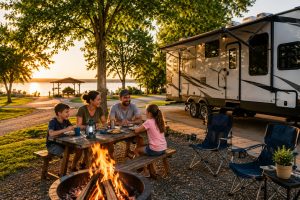
On paper, a lakefront campground in the Ark-La-Tex sounds like the obvious summer choice for a family trip — water access, swimming, the whole outdoor package. In practice, parents who’ve done both often tell a different story. The appeal of a developed RV park versus a lakefront Corps campground in East Texas summer heat is more nuanced than the waterfront view makes it seem.
Here’s the comparison, family by family, situation by situation.
The Lakefront Campground Argument — and Where It Falls Short
The case for a lakefront campground is easy to make. Wright Patman Lake is 20,300 acres of East Texas reservoir with multiple Corps-managed campgrounds around its shoreline. Swimming beaches, boat ramp access, fishing from the bank, and the visual appeal of waking up 50 feet from the water — these are genuine advantages that a city-adjacent RV park can’t replicate.
But the lakefront camping experience in East Texas in July comes with specific trade-offs that the waterfront view doesn’t mention. Most Corps campgrounds at Wright Patman offer electric-only or water/electric hookups at best — no sewer. That means dumping the black tank every few days, either at an on-site dump station (if one exists) or by driving to a service station. In July heat with kids generating the full family waste load, the tank fills faster than you’d expect and the logistics become a recurring interruption to the trip.
Shower facilities at Corps campgrounds range from adequate to genuinely rough depending on the specific campground and its current maintenance status. Restrooms are typically vault toilets or basic flush facilities shared by the whole campground. For adults who’ve done wilderness camping before, these are manageable. For families with young children — particularly toddlers and preschoolers who need the bathroom with frequency and at inconvenient times — a 200-yard walk to a shared vault toilet at 2 a.m. is a different experience than a private bathroom in the rig.
“The lake is beautiful. The Corps campground with a 4-year-old in July, when the power keeps the lights on but the nearest flush toilet is a 3-minute walk across a dark campground… that’s a different trip than the brochure.”
What Full Hookups Actually Mean for a Family
The most consistent reason families with children choose a developed RV park over a lakefront campground comes down to what “full hookup” actually delivers in a summer camping context. Electric, water, and sewer at the site — not shared facilities, not a dump station run on Tuesday morning, but connected utilities at your rig’s door.
Electric means air conditioning runs all night without generator noise or battery anxiety. In East Texas July, overnight lows in the upper 70s mean the tent or the non-hooked-up RV does not cool down to comfortable sleeping temperature without active cooling. The child who sleeps through anything might handle 78°F at 2 a.m. Most children don’t, and neither do most parents. A full-hookup site with the AC set to 72°F is the difference between a well-rested family and a family that’s managing sleep deficits by day three.
Water at the site means filling the fresh tank is a hose connection, not a campground water station trip with jugs. Sewer at the site means the black tank gets dumped when you decide, not when capacity forces the issue. These sound like minor conveniences. Over a five-day family trip with three kids and the associated domestic logistics of feeding, bathing, and managing a functional mobile household, they’re the difference between camping and survival exercise.
Safety Considerations That Parents Actually Think About
Lakefront camping with young children has specific safety considerations that make some parents genuinely reluctant, regardless of how well-supervised they plan to be.
Open Water Access at Corps Campgrounds
Wright Patman Lake’s Corps campgrounds vary in how their sites relate to the water’s edge. Some campsites are set back significantly from the shoreline; others are close enough that a child who wanders from the campsite could reach the water quickly. There are no fences. There are no lifeguards. Swimming beaches at some Corp locations are designated and monitored during staffed hours, but the campsite areas themselves are unfenced open waterfront. For families with toddlers and preschoolers who require constant supervision near water, the additional supervision burden of an open lakefront campsite adds a specific fatigue layer that parents managing kids in the heat are already carrying.
The Controlled Environment Advantage
A developed RV park has a different safety profile — it’s a bounded space with roads designed for slow traffic, site boundaries, and the general awareness that comes from being around other families rather than in an isolated lakefront campsite. The kids-on-bikes-around-the-loop-road dynamic that makes an RV park a summer camping experience for school-age children requires a different level of parental supervision than a lakefront site where the water is accessible and the campsite neighbors may or may not be present.
The Day Trip Strategy: Lake Without Living at the Lake
The best family camping strategy in the Texarkana area often isn’t choosing between the RV park and the lake — it’s using the RV park as a home base and the lake as a day trip destination. This approach gets you the full-hookup overnight comfort of a developed park (air conditioning, connected sewer, real showers) alongside the lake day experience (swimming, fishing, a boat on Wright Patman) without committing to the lakefront camping logistics as your daily living situation.
Wright Patman Lake is 20 miles from Texarkana — roughly 30 minutes in normal traffic. A day trip to the lake, returning to the RV park in the evening for dinner and the bedtime routine in air-conditioned comfort, produces the summer camping experience families are actually looking for without the infrastructure compromises of lakeside camping.
The family that spends two days at the lake and two evenings grilling at their full-hookup site with the kids playing on the playground and the AC running through the night is having a more sustainably enjoyable trip than the family that’s sweating through night three on a Corps campsite and managing a black tank situation in the morning heat.
When Lake Camping Does Win for Families
Being fair about this comparison means acknowledging the situations where the lakefront campground genuinely is the better choice. Families with older kids — 10 and up — who are self-sufficient campers, can handle a vault toilet without drama, don’t need nighttime AC to sleep, and actively want the full immersion experience of living at the water’s edge. Families with boats who need the immediate ramp access. Families with fishing as the centerpiece activity who want the early morning lake access that a 30-minute drive disrupts. In these situations, the lake wins and the RV park is the compromise rather than the improvement.
The families for whom an established Texarkana-area RV park makes more sense are specifically: families with children under 8, families where sleep quality is a non-negotiable survival variable, families who value the predictability of reliable facilities over the adventure of figuring out logistics in real time, and families doing their first summer camping trip who want a controlled-enough environment to actually enjoy the experience rather than just endure it. For travelers coming from the Boston, Texas corridor west of Texarkana, the RV park near Boston, TX page gives the relevant access and routing information.
Full hookups: RV park wins. Corps campgrounds at Wright Patman: electric-only or W/E at most sites. No sewer at site = dump station logistics mid-trip.
Bathrooms: RV park wins for families with young children. Corps: shared vault or basic flush, walk required at night.
AC for sleep: RV park wins. Overnight lows of 75–79°F in July make sleeping without AC difficult for children. Full hookup = AC all night, no generator.
Water access: Lake campground wins if water is the primary activity. RV park + day trip to Wright Patman gives 90% of the lake experience with 0% of the logistics.
Child safety near water: RV park has edge for families with under-5s. Open lakefront sites require more supervision.
Older kids/anglers: lake campground is genuinely better. The advantages shift when kids are older and self-sufficient.
For families planning a summer trip in the Texarkana area and weighing the options, the Texarkana area RV travel and activity guide covers the regional picture including day trip options to Wright Patman Lake, Caddo Lake, and the surrounding East Texas and Southwest Arkansas outdoor destinations. For longer-term or semi-permanent family stays in the area, the manufactured home park options at RV Park Texarkana cover that extended-stay picture. And for booking a family summer stay, RV Park Texarkana is where the reservation starts.
Frequently Asked Questions
Is RV Park Texarkana good for families with young children?
Yes — the full-hookup infrastructure of an established RV park is particularly well-suited to families with young children in summer. Full electric hookup means air conditioning runs all night, which is the single most important comfort variable for families with children who need consistent sleep in the East Texas July heat. On-site or in-rig bathroom facilities eliminate the nighttime walk to shared campground restrooms that makes lakefront Corps campgrounds challenging with young children. The controlled RV park environment — slower roads, defined sites, other families nearby — creates a supervision context that’s more manageable than an open lakefront campsite adjacent to water that requires constant monitoring for toddlers and preschoolers.
How far is Wright Patman Lake from Texarkana RV Park?
Wright Patman Lake is approximately 20 miles south of Texarkana on the Sulphur River — roughly 25 to 35 minutes of driving depending on the specific access point around the lake you’re heading to. The distance makes it an easy day trip from RV Park Texarkana: leave after breakfast, spend the day at the lake swimming and fishing, return in the late afternoon before the dinner hour. Day-use areas at the Corps campgrounds around Wright Patman are accessible without a camping reservation; some have nominal day-use fees. The drive to the lake and back is an entirely reasonable daily activity that allows you to enjoy the lake experience while maintaining the comfort and infrastructure of the full-hookup RV park for overnight stays.
What are the typical hookup types at lakefront campgrounds near Texarkana?
The US Army Corps of Engineers campgrounds at Wright Patman Lake — the primary lakefront camping option near Texarkana — typically offer electric-only (30-amp) or water and electric (W/E) hookups at most sites. Sewer hookups at the site are uncommon in most Corps campground configurations; dump stations may be available on-site but require a separate trip to use rather than continuous drain connection. This means families camping in RVs at lakefront Corps sites are managing the black and grey tank capacity throughout their stay, which becomes a logistics factor on longer trips with full family use. Full sewer hookup at the site — the arrangement at established RV parks — eliminates this management requirement entirely.
Are there playgrounds or activities for kids at Texarkana-area RV parks?
Established RV parks in the Texarkana area typically have on-site amenities specifically suited to family camping — playgrounds, open recreation areas, and the general infrastructure that makes keeping children engaged on a multi-day stay easier than a rustic campground without developed facilities. The specific amenities at any given park are best confirmed directly with the park when booking, as offerings vary. The combination of on-site family amenities and the 20-minute day-trip access to Wright Patman Lake’s swimming and fishing gives families both structured on-property activity and the outdoor lake experience that makes summer camping in East Texas worth the trip.
Can families with dogs camp at RV Park Texarkana?
Most established RV parks, including those in the Texarkana area, accommodate dogs with standard pet policies — leash requirements, owner responsibility for cleanup, and sometimes size or breed restrictions depending on the specific park’s rules. Confirming the current pet policy at the time of booking rather than assuming standard dog-friendly terms apply is the right approach. The Fourth of July and other summer holiday weekends are worth a specific note if you’re bringing a dog with noise anxiety — fireworks throughout the Texarkana area during the holiday create a sustained noise environment that some dogs find genuinely distressing and that requires active management rather than just hoping the dog handles it.
What’s the best summer camping option for families who want lake access but also want full hookups?
The base-camp day-trip approach is the most practical solution for families who want both. Stay at a full-hookup Texarkana-area RV park for the overnight comfort and infrastructure — air conditioning, connected sewer, proper shower facilities — and make Wright Patman Lake a day trip destination rather than a campsite. The 20-mile drive gives you lake access for swimming and fishing during the day while the full-hookup site handles the heat management and sanitation logistics that make a multi-day family camping trip comfortable. This approach also gives flexibility — you can go to the lake on the days that work for it and do other activities (Texarkana attractions, Caddo Lake day trip) on the days that don’t, rather than being committed to the lakefront location for every day of the trip.