
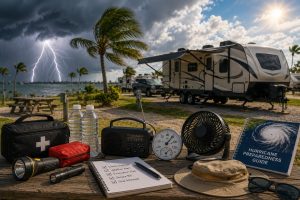
The Ark-La-Tex summer brings three genuinely distinct weather hazards that RVers need to take seriously, often within the same season and sometimes the same week: severe heat, severe thunderstorms with real tornado potential, and the tail end of Gulf hurricane systems that can bring significant rain and wind well inland from the coast. None of these are exotic risks specific to RVing — they’re regional realities that any Texarkana-area resident manages every summer. RVers just need the specific version of that awareness that applies to a mobile, less-sheltered structure.
Texarkana sits in a genuinely active severe weather zone — not the heart of classic Tornado Alley, but close enough to the broader Ark-La-Tex severe weather corridor that thunderstorms capable of producing damaging wind, large hail, and tornadoes are a real feature of the regional spring and summer climate. Layer onto that the region’s serious summer heat and the occasional remnant impact from a Gulf tropical system, and RVers in the area are managing a genuinely broader range of weather hazards across a single season than campers in many other parts of the country.
Heat Safety: The Daily Risk
Heat is the most consistent and statistically significant weather hazard RVers face in a Texarkana summer — more consistent than severe storms, and more likely to actually affect a given day of your stay. July and August regularly produce afternoon temperatures in the mid-90s to occasionally over 100°F, with the region’s humidity making the heat index feel considerably higher than the actual air temperature.
Practical Heat Management
Confirm your RV site has appropriate electrical service (50-amp for larger rigs running multiple AC units) before you need it, not after the first heat wave arrives. Pre-cool your rig in the morning while temperatures are still manageable, then run AC continuously through the peak afternoon hours rather than trying to cool a rig that’s already heated up. Hydrate consistently throughout the day, not just when you feel thirsty — heat-related illness develops gradually and is often well underway before someone notices clear symptoms. Know the signs of heat exhaustion (heavy sweating, weakness, cool clammy skin, nausea, headache) and heat stroke (high body temperature, hot dry or damp skin, confusion, loss of consciousness) — heat stroke is a medical emergency requiring immediate care.
Never leave children, pets, or anyone in a closed vehicle or RV without functioning AC during peak summer heat, even briefly — interior temperatures in a closed vehicle or RV can rise to dangerous levels within minutes in direct summer sun.
Severe Thunderstorm and Tornado Awareness
The Ark-La-Tex region experiences genuine severe thunderstorm and tornado risk, particularly during spring and into early summer, though summer thunderstorm activity capable of producing damaging winds and occasional tornadoes continues through the season. Understanding the specific vulnerability of RVs to this risk is essential: RVs, like mobile and manufactured homes, are not safe structures to shelter in during tornado warnings or severe straight-line wind events. The National Weather Service and FEMA are explicit on this point — RVs offer minimal protection against tornado-force winds, and the guidance for anyone in an RV during a tornado warning is to evacuate to a sturdier structure immediately.
What to Do Before the Season and Before a Storm
Know your RV park’s severe weather plan before you need it — ask specifically at check-in whether the property has a designated storm shelter or sturdy building, and what the park’s notification process is during severe weather. Download a weather alert app or ensure you have a NOAA Weather Radio or equivalent that will alert you to warnings even if you’re asleep or not actively checking forecasts, since many severe weather events, including tornadoes, can develop and strike with limited advance notice.
When a tornado watch is issued, this means conditions are favorable for tornado development — a good time to review your evacuation plan and stay alert to changing conditions, without yet needing to take shelter. When a tornado warning is issued, this means a tornado has been spotted or indicated by radar and is an immediate threat — move to your designated sturdy shelter immediately, don’t wait to see the storm yourself, and don’t attempt to outrun a tornado in a vehicle unless a professional evacuation route has been specifically identified and there’s clear time to execute it.
“The RVers who take severe weather seriously in this region aren’t being dramatic about it — they’re just responding to a genuine regional risk the same way any local homeowner would. Know where the shelter is before the storm, not during it.”
Hurricane-Season Awareness for an Inland Location
Texarkana is well inland from the Gulf Coast, but the Atlantic hurricane season (June 1 through November 30) still carries real relevance for RVers in the region. Tropical systems making landfall on the Gulf Coast frequently track inland afterward, and their remnant circulation can bring significant rainfall, gusty winds, and even embedded tornadoes to the Ark-La-Tex region days after the storm’s initial coastal landfall. This isn’t a hurricane-force wind event by the time it reaches this far inland in most cases, but the rainfall totals from a slow-moving tropical remnant system can be substantial enough to cause meaningful flooding, and the tornado risk embedded in a tropical system’s outer rain bands is a genuine, if often underappreciated, hazard even hundreds of miles from the coast.
Monitoring the National Hurricane Center (nhc.noaa.gov) during active hurricane season, particularly when a system is projected to make Gulf landfall anywhere from Texas to the Florida Panhandle, gives advance notice of potential inland impacts to the Texarkana area days before the remnant system actually arrives. This lead time is valuable specifically because it’s more than the sometimes-limited warning window that a spontaneously developing summer thunderstorm provides.
Building a Realistic Summer Weather Plan
Bringing all three hazards together into a coherent plan: check the forecast daily during your stay, not just when booking, since summer weather in this region can shift meaningfully within a single week. Know your specific RV park’s severe weather shelter plan before any weather develops. Keep a weather radio or reliable alert app active, especially overnight when thunderstorms can develop while you’re asleep. Monitor the National Hurricane Center during active hurricane season if any Gulf system is developing. And treat heat safety as a daily practice rather than an occasional concern, since it’s the hazard most likely to actually affect your stay on any given day.
Heat: pre-cool mornings, run AC through peak afternoon, hydrate consistently, know heat exhaustion/heat stroke symptoms. Never leave anyone in a closed vehicle/RV without AC.
Severe storms: RVs are NOT safe tornado shelter. Know your park’s designated shelter before a storm. Tornado watch = stay alert. Tornado warning = shelter immediately.
Hurricane season (June 1-Nov 30): monitor nhc.noaa.gov during active Gulf systems. Remnant storms can bring significant inland rain, wind, and embedded tornado risk to Texarkana days after coastal landfall.
Official sources: weather.gov (NWS), nhc.noaa.gov (NHC), local county emergency management.
Ask your RV park at check-in: designated shelter location, severe weather notification process.
For guests planning a Texarkana summer stay, the RV travel and Texarkana area guide covers the broader regional picture beyond weather considerations. Current rates for any length stay are at the RV Park Texarkana pricing page. Guests who want the added shelter and comfort of a cabin during unpredictable summer weather can check the cabin accommodations at RV Park Texarkana. Visitors approaching from the Hope, Arkansas corridor can check the RV park near Hope, AR page. And for booking any Texarkana stay, RV Park Texarkana is the starting point.
Frequently Asked Questions
Is it safe to stay in an RV during a tornado warning?
No. RVs, like mobile and manufactured homes, do not provide adequate protection during tornado-force winds and are explicitly identified by the National Weather Service and FEMA as unsafe structures to shelter in during a tornado warning. If a tornado warning is issued for your location, evacuate to a sturdier permanent structure immediately — ideally a designated storm shelter, a basement, or an interior room on the lowest floor of a sturdy building away from windows. Confirming your RV park’s designated severe weather shelter location at check-in, before any storm develops, is an essential step for anyone staying in an RV in a region with real tornado risk like the Ark-La-Tex.
Does Texarkana get hurricanes?
Texarkana does not experience direct hurricane landfall, as it’s well inland from the Gulf Coast. However, tropical systems that make landfall on the Gulf Coast frequently track inland afterward, and their remnant circulation can bring significant rainfall, gusty winds, and even embedded tornadoes to the Ark-La-Tex region, sometimes several days after the storm’s initial coastal landfall. While these inland impacts are generally not hurricane-force wind events by the time they reach Texarkana, the rainfall and embedded severe weather risk from a slow-moving tropical remnant system can still be significant. Monitoring the National Hurricane Center (nhc.noaa.gov) during active hurricane season (June 1 through November 30) when Gulf systems are developing gives useful advance notice of potential inland impacts.
What are the signs of heat exhaustion and heat stroke?
Heat exhaustion symptoms include heavy sweating, weakness, cool and clammy skin, nausea, headache, and dizziness — this stage requires moving to a cooler location, hydrating, and resting, and typically resolves with prompt attention. Heat stroke is a medical emergency and includes symptoms of high body temperature (above 103°F), hot dry or damp skin, rapid strong pulse, confusion, and possible loss of consciousness — heat stroke requires immediate emergency medical attention (call 911) while attempting to cool the person down with any available means while waiting for help. Given the Ark-La-Tex’s regular mid-90s to 100°F+ summer temperatures, taking heat safety seriously as a daily practice rather than an occasional concern is advisable for anyone spending extended time outdoors or in an RV during peak summer months.
How do I know if my RV park has a severe weather shelter?
Ask directly at check-in whether the RV park has a designated storm shelter, a sturdy on-site building suitable for tornado shelter, or a specific evacuation plan for severe weather events. Not all RV parks have a dedicated storm shelter on-site, and knowing this in advance — rather than discovering it during an active severe weather event — allows you to plan an alternate shelter location (a nearby sturdy public building, for instance) if the park itself doesn’t have adequate on-site shelter. This is a reasonable and common question for RV parks in a region with genuine severe thunderstorm and tornado risk, and a well-prepared property should have a clear answer readily available.
What is the difference between a tornado watch and a tornado warning?
A tornado watch means atmospheric conditions are favorable for tornado development in and around the watch area — it’s a signal to stay alert, review your shelter plan, and monitor weather updates, but it does not mean a tornado has been detected. A tornado warning means a tornado has actually been spotted by trained observers or indicated by weather radar and poses an immediate threat to the warned area — this requires taking shelter immediately in your designated safe location without waiting to visually confirm the tornado yourself. Understanding this distinction and having a NOAA Weather Radio or reliable weather alert app that will notify you of warnings, even overnight, is essential for anyone camping or RVing in a region with real severe weather risk like the Ark-La-Tex.
What should I monitor during hurricane season if I’m RVing near Texarkana?
During Atlantic hurricane season (June 1 through November 30), monitoring the National Hurricane Center at nhc.noaa.gov for any tropical system developing in the Gulf of Mexico is advisable, particularly when a storm is projected to make landfall anywhere from Texas through the Florida Panhandle, since these systems can track inland and affect the Ark-La-Tex region with significant rainfall and embedded severe weather days after coastal landfall. The National Weather Service (weather.gov) also issues relevant flood and severe weather alerts for the local area as any system approaches. This advance monitoring gives more lead time than the often-limited warning window of a spontaneously developing summer thunderstorm, allowing for better trip planning around a known developing system.