
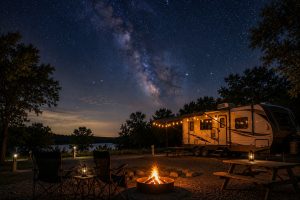
The best skies around Texarkana are the ones you find after you’ve driven a few miles from the city lights and let your eyes adjust. What’s up there — what’s always been up there — tends to surprise people who’ve been inside too long.
For RV travelers camped outside the city proper — at an RV park on the rural fringe rather than in a commercial corridor — the night sky near Texarkana is considerably better than most visitors expect. This guide covers where to look, what you’ll see, and how to make the most of the quiet evening hours that are part of any good camping stay.
The Light Pollution Context: What Texarkana’s Sky Is Actually Like
Let’s be honest about what we’re dealing with here. Texarkana is a metro area of about 150,000 people straddling the Texas-Arkansas state line. The city generates real light pollution, and immediately within the city, the night sky shows what any mid-sized American city’s sky shows — enough ambient light that the fainter stars disappear and the Milky Way is not visible.
But Texarkana is not sprawling. The developed area is relatively compact, and the surrounding countryside in all directions is genuinely rural — agricultural land, pine forest, the swampy bottomland of the Red River and its tributaries. The light pollution gradient drops off faster here than in cities with larger suburban footprints. Get 10 to 15 miles from the city center in any direction and the sky quality improves meaningfully.
RV parks positioned outside the city’s commercial core benefit from this gradient. An RV park on the rural fringe — as opposed to one adjacent to the I-30 commercial strip — is already positioned in a meaningfully different light environment. The specific difference between the sky at a rural RV park and the sky at an urban hotel parking lot is the difference between seeing the Milky Way as a feature and seeing it as a vague suggestion.
“East Texas has some of the darkest rural corridors in the region, and Texarkana sits at the edge of that darkness. You don’t have to go far from the city to find genuinely good sky.”
East Texas Dark Skies: What the Region Offers
The broader East Texas stargazing picture is worth understanding because the Texarkana area connects to some of the darker sky terrain in the South-Central United States.
East Texas and Southwest Arkansas have low population density across significant stretches of the region — the Piney Woods, the national forests (Sabine National Forest to the south, Ouachita National Forest to the north across the Arkansas border), and the agricultural flatlands that stretch between them. These areas are among the darker sky zones in the region according to the Bortle Dark-Sky Scale — the measure used by astronomers to quantify sky darkness. While the Texarkana area itself doesn’t approach the truly dark sky territories of West Texas or rural New Mexico, the surrounding countryside achieves Bortle 4-5 conditions in the darker rural pockets — sufficient to see the Milky Way clearly on moonless nights and to observe the fainter Messier objects with binoculars.
The Bortle Scale and What It Means Practically
For non-astronomers, Bortle 1 is the darkest possible sky (found in very remote locations); Bortle 9 is an inner-city sky where only the brightest stars are visible. The darker rural corridors within 20 to 30 miles of Texarkana typically achieve Bortle 4 to 5 on moonless nights — a sky where the Milky Way is visible with some structure, faint nebulae are accessible with binoculars, and a naked-eye observer can pick out hundreds of stars rather than the dozens visible from a typical suburban yard. The Light Pollution Map (lightpollutionmap.info) allows location-specific sky quality checks and is a useful tool for identifying the darkest sites nearest to any given location.
What You’ll See: A Seasonal Sky Guide
The East Texas sky through the year offers different main attractions depending on the season. Each has its highlights for naked-eye and binocular observers.
Winter (December through February)
Winter evenings bring the most dramatic naked-eye constellation display of the year: Orion dominates the southern sky with his distinctive three-star belt and the glowing nebula visible just below it to the naked eye (M42, the Orion Nebula). Taurus holds the Pleiades cluster (Seven Sisters) high in the west — a tight, bright cluster of stars that resolves into dozens of individual members through binoculars. Canis Major rises in the southeast with Sirius, the brightest star in the entire night sky. Winter skies in East Texas are clear more often than the spring and fall seasons, and the cool temperatures make extended outdoor viewing comfortable in ways that summer humidity doesn’t.
Spring (March through May)
Spring evenings bring Leo and Virgo rising in the east, and the great galaxy season for binocular observers — the Virgo Cluster of galaxies (a collection of over 1,300 galaxies centered about 50 million light-years away) is accessible with a modest instrument under dark rural skies. Jupiter and Saturn are typically well-placed for viewing in alternating years during spring evenings. The winter Milky Way sets in the west as the summer Milky Way begins to rise in the pre-dawn hours.
Summer (June through September)
Summer is the Milky Way’s best season for observers in the Northern Hemisphere. The galactic core — the densest, brightest section of our galaxy’s disk — rises in the south during summer evenings and is visible as a distinct band of light stretching from horizon to horizon on dark, moonless nights. The Summer Triangle asterism (Vega, Altair, and Deneb) dominates the overhead sky. East Texas summer nights are warm and humid, which makes extended outdoor viewing less comfortable than winter — but the sky itself is spectacular on clear nights, and late summer provides the best overall conditions for Milky Way photography.
Fall (October through November)
Fall evenings offer the Great Square of Pegasus high in the south, the Andromeda Galaxy visible to the naked eye as a faint smudge on dark nights (the farthest object a human eye can see unaided — 2.537 million light-years away), and the Perseus Double Cluster accessible with binoculars. The Orionid meteor shower peaks in late October, producing 10 to 20 meteors per hour under optimal conditions.
Making the Most of an Outdoor Evening at the RV Park
The practical elements that separate a memorable outdoor evening from an unremarkable one are mostly simple and mostly about preparation.
Dark adaptation takes 20 to 30 minutes. Your eyes need that time to adjust to low light, and any bright light source during that window resets the adaptation clock. Turning off phones or switching to red-light mode (most astronomy apps have this), avoiding the lantern or flashlight for the first half hour, and letting the darkness come in gradually produces a meaningfully better sky view than stepping out at full urban eye adaptation.
Timing matters. New moon phases produce the darkest skies; a full moon washes out everything but the brightest stars and planets. Checking the moon phase before planning a stargazing evening is basic preparation. Clear.outside is a free astronomy weather app that forecasts cloud cover, transparency, and seeing conditions — more useful than a general weather app for planning outdoor observation.
Binoculars are the most underrated astronomy tool for casual observers. A basic 7×50 or 10×50 binocular opens up the Pleiades cluster, the Orion Nebula, the Milky Way’s star clouds, and dozens of open clusters and nebulae that aren’t visible to the naked eye but don’t require a telescope’s investment or setup time. If you have binoculars in the RV already, they’re the right instrument for an outdoor evening at the park.
Best sky direction from the city: west and north toward the darker rural corridors and pine forest country.
Best months: January–February (clearest, Orion and winter sky), August–September (Milky Way core, summer sky).
Moon phase: check before going out. New moon = darkest sky. Full moon = bright sky with limited deep-sky visibility.
Tools: binoculars (7×50 or 10×50 minimum), phone in red-light mode, a reclining chair, 30 minutes of dark adaptation.
Apps: Sky Map / SkySafari for identification, Clear.outside for weather/transparency forecasting, Light Pollution Map for site selection.
For visitors to the Texarkana area who want to understand the full range of outdoor and evening activities the region supports, the Texarkana area exploration guide covers the day and evening activity landscape beyond the sky above you. And for planning an RV stay that puts you outside the city’s light envelope with a genuinely good rural sky overhead, RV Park Texarkana is the starting point for a stay that makes the most of the region’s outdoor evenings.
Frequently Asked Questions
How dark is the night sky near Texarkana?
The sky within the Texarkana city limits shows the light pollution typical of a mid-sized American metro — bright enough that the Milky Way is at best faint and the fainter stars disappear. In the rural countryside 10 to 15 miles from the city center, sky quality improves to Bortle 4-5 conditions on moonless nights — dark enough to see the Milky Way as a distinct band with structure, the Andromeda Galaxy with the naked eye, and dozens of deep-sky objects with binoculars. The Light Pollution Map at lightpollutionmap.info allows you to check specific site quality in advance. RV parks on the rural fringe of the city benefit from this darker sky environment compared to parks within the developed commercial corridors.
When is the best time of year to stargaze near Texarkana?
Winter (December through February) offers the best combination of sky clarity, comfortable cool temperatures, and the year’s most spectacular naked-eye constellation display — Orion, the Pleiades, Sirius, and Canis Major dominate a sky that’s reliably clearer than the spring and fall seasons. Summer (June through September) offers the Milky Way galactic core at its best placement for Southern observers, but East Texas summer humidity and warmth make extended outdoor viewing less comfortable. Fall brings the Andromeda Galaxy and the October meteor showers. Any season on a moonless, clear night produces a good sky in the rural Texarkana area; choosing a new moon phase improves any season’s viewing significantly.
Can I see the Milky Way from Texarkana?
From within the city, the Milky Way is at best faintly visible as a diffuse brightening along a band of sky — the light pollution suppresses the fainter stars that give it its characteristic texture. From rural locations 10 to 20 miles from the city on dark, moonless summer nights, the Milky Way is clearly visible as a structured band of light crossing the sky, with the galactic core rising in the south appearing as a distinct bright region. Summer evenings (June through September) are the best season for Milky Way viewing in the Northern Hemisphere. The ideal conditions are a new moon, a clear night, and positioning away from any nearby agricultural or commercial lighting in addition to the city itself.
What equipment do I need for stargazing at a campsite?
You don’t need a telescope to have a rewarding stargazing experience from a campsite. The minimum useful equipment is a pair of binoculars — 7×50 or 10×50 — which opens up a remarkable range of objects invisible to the naked eye (star clusters, nebulae, individual stars in the Milky Way’s star clouds) without the setup overhead of a telescope. A reclining camping chair or a blanket on the ground makes an extended observation session comfortable. A smartphone with a stargazing app (SkySafari, Star Walk, or Sky Map) helps identify what you’re looking at. Use red-light mode on your phone to preserve dark adaptation. A moon phase calendar or the Clear.outside app for weather and transparency forecasting completes the minimal kit for a productive evening.
Are there any dark sky parks or observatories near Texarkana?
The Texarkana area doesn’t have a formally designated dark sky park or public observatory in the immediate vicinity. The nearest designated facilities are several hours away — the McDonald Observatory in West Texas (approximately 7 hours), which is one of the premier public observatory programs in the country with regular public viewing nights. Locally, the darker rural corridors in the Caddo Lake area south of Texarkana and the pine forest country of the Ouachita National Forest to the north across the Arkansas border offer informal dark sky access without established facilities. For casual camping observers, the rural RV parks outside the city’s developed area provide the best accessible combination of dark sky quality and comfortable observation conditions in the immediate region.
What is the best stargazing app for a camping trip?
Several apps serve different stargazing needs well. SkySafari (paid, $3-$15 depending on version) is the most comprehensive for identification, with a large database and detailed information on individual objects. Sky Map (free, Google) is a simple augmented reality pointer that identifies what you’re pointing your phone at. Clear.outside (free) is the best weather tool for stargazing — it forecasts cloud cover, atmospheric transparency, and seeing conditions specifically for astronomy. Light Pollution Map (web-based, free at lightpollutionmap.info) is useful before arriving at a site to evaluate the sky quality at a specific location. All of these work in airplane mode once loaded, which is important for preserving dark adaptation — switch your phone to red-light mode and brightness minimum before your session begins.