
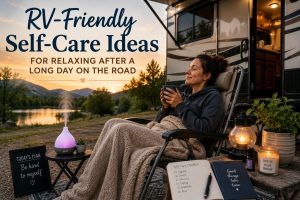
The driving is done. The rig is parked. And now your body is quietly asking you to please, for the love of everything, just stop moving for a while.
The temptation is to eat something and fall asleep watching television. And sometimes that’s exactly right. But building a few deliberate RV self-care tips into your post-drive routine makes a genuine difference in how you feel the next morning — and in how sustainable the travel lifestyle is over weeks and months.
This guide walks through the best RV relaxation ideas that actually fit the campsite reality — no spa required, no elaborate setup, just practical ways to help your body and mind recover from the road so you can enjoy the reason you’re out there.
Why Recovery Matters More in RV Travel Than Most People Think
Long-distance driving is physically demanding in ways that aren’t always obvious until you’ve been doing it for a while. Sustained concentration activates the nervous system at a low but consistent level. Gripping a steering wheel, monitoring mirrors, and making continuous micro-adjustments creates muscle tension that accumulates through the day — particularly in the neck, shoulders, upper back, and hands. The vibration of a large vehicle, even on smooth roads, adds to that physical load.
Add in the mental load of navigation, site selection, hookup logistics, and the general unfamiliarity of being in a new location every day or every few days, and you have a reliable formula for feeling more wrung out than the day’s actual events might justify.
Travel recovery tips for RV life aren’t about luxury or indulgence. They’re about maintaining the physical and mental capacity to keep enjoying the trip. The people who sustain long RV journeys well are almost always the ones who take their recovery seriously — not just their driving.
“The drive is the obvious part of RV travel. The recovery is the part that determines whether tomorrow’s drive is something you’re looking forward to.”
Start With the Body: Physical Recovery at the Campsite
Relaxing at the campsite after a long drive starts with acknowledging what driving actually does to your body — and then working against it deliberately.
The Five-Minute Walk Before You Sit Down
This sounds almost too simple, but it’s genuinely one of the most effective things you can do after a long drive. Before you set up the awning, before you start dinner, before you do anything else — take a five-minute walk around the campground. Not exercise, just movement. Walking after sustained sitting resets circulation, loosens the hip flexors that shorten with prolonged driving, and signals your nervous system that the alertness state required for driving is over.
It’s a transitional ritual as much as a physical one. The walk is the dividing line between the driving part of the day and the rest of it. A lot of experienced RV travelers do some version of this automatically without thinking of it as self-care — they just know they need to move before they can properly settle.
Targeted Stretching for Drivers
The specific muscles that take the most strain from long-distance driving are predictable: the hip flexors from prolonged sitting, the piriformis and glutes from static load on the seat, the upper trapezius and levator scapulae from shoulder tension, and the neck from head-forward posture and mirror-checking. A ten-minute stretch sequence targeting these areas — nothing elaborate, just conscious lengthening of the muscles that have been held tense — makes a measurable difference in how you feel by the next morning.
Hip flexor stretch, seated pigeon or figure-four for the glutes, neck rolls and lateral neck stretch, shoulder rolls and doorframe chest stretch. These don’t require a yoga mat or a class. They require five square feet and about ten minutes of willingness to do something that looks mildly ridiculous in a campground. Worth it entirely.
A Proper Shower
This one matters more than people give it credit for. Not just as hygiene — as a genuine reset signal for the body. Warm water on tense muscles has real physiological effects: it increases local circulation, reduces muscle spindle activity (the tension mechanism), and lowers cortisol slightly. A shower after driving isn’t just cleaning up. It’s a physical transition that most people find makes them meaningfully more relaxed within twenty minutes of finishing.
In an RV shower, water conservation habits still apply — but a warm, unhurried shower that you take specifically for the recovery benefit rather than the efficiency of getting clean is a different thing than a functional rinse. If you have a full hookup and a reasonable tank situation, letting the shower be a real recovery tool is worth it occasionally.
The Mind Side of Recovery: Stress Relief After the Road
Stress relief for RV life requires acknowledging that driving stress is real, even when the drive was uneventful. The nervous system doesn’t distinguish between stressful situations that worked out fine and ones that didn’t — the physiological activation is similar either way. Coming down from a day of heightened attention and awareness requires some deliberate downshift, not just the passage of time.
The One-Hour Rule
Give yourself one hour at the campsite before making any decisions about the next leg of the trip. No route planning, no campground research, no logistics management. Just be where you are. This boundary sounds like a small thing, but the cognitive load of travel planning is part of what keeps the nervous system in a low-level activated state even after you’ve stopped moving. A clean break — one hour that belongs completely to the present location — helps the actual downshift happen.
Something That Has Nothing to Do With Travel
A book you’re reading that isn’t about travel destinations. A podcast that makes you laugh. A card game or a crossword. Something that lives in the “regular life” category rather than the “travel” category. The mind needs contrast, not just rest. Engaging with something that feels like home life — even if home is currently a parking spot in East Texas — creates that contrast and helps break the travel-mode mental loop.
Cooking a Real Meal
This one surprises people, but it works. The physical and mental engagement of preparing a proper meal — not reheating something, but actually cooking — has a documented stress-reduction effect for people who find the activity engaging rather than burdensome. The sensory involvement, the sequential task focus, the reward of a good result. For RV travelers who enjoy cooking, making a real dinner after a long drive is a genuine recovery activity, not just dinner.
The Outdoor Component: Sitting Still Outside
One of the genuine gifts of wellness for RV travelers is the outdoor environment. After a day spent inside a moving vehicle — even a comfortable one — being outside and stationary is itself restorative. The change in sensory environment, the natural light, the ambient sounds of a campground or nature area — all of it contributes to the parasympathetic shift that recovery requires.
Set up the awning. Put out the chairs. Make something hot or cold to drink. And then just sit there for a while. No phone, no planning, no productivity. Just the particular pleasure of being somewhere that isn’t moving, in the open air, without anything specific you’re supposed to be doing.
This is one of the most underrated aspects of the RV lifestyle — the access it gives you to exactly this experience, in genuinely different places, regularly. A campground chair in the Texarkana area is a different evening than one in the mountains or on a coastal site. The variety is part of what makes the recovery so good.
For RV travelers passing through the Texarkana region and looking for a well-set-up park to make this kind of evening properly possible, RV Park Texarkana is worth knowing about — the kind of place where the hookups work reliably and the space is set up for exactly this kind of end-of-drive recovery.
Setting Up Your Campsite for Better Recovery
The physical arrangement of your outdoor space at the campsite affects how well you’re able to use it for actual relaxation. A few things that matter more than they might seem:
Chair placement relative to the sun and wind — being comfortable is the baseline requirement, and it takes about two minutes to optimize. Level ground for the rig affects sleep quality more than most people realize — a slight unlevel surface that you don’t bother correcting adds to physical tension through the night. And the general organization of the site — gear stowed, cables managed, the campfire or outdoor light set up — removes the ambient visual clutter that keeps the brain in light problem-solving mode when you’re trying to rest.
If you’re relatively new to building out a comfortable RV life routine, the RVing lifestyle guide covers a lot of the foundational habits that experienced travelers develop around exactly this kind of daily wellbeing on the road.
Sleep: The Most Important Recovery Tool
Everything else in this guide is preparation for sleep. A proper night of sleep in a comfortable, leveled, properly ventilated RV is the recovery mechanism that actually rebuilds the capacity for the next day of travel. The stretching, the shower, the outdoor time, the mental downshift — they all work in service of better sleep.
A few specific things that improve RV sleep quality: blackout curtains (campground lighting is often surprisingly intrusive), a consistent bedtime that doesn’t slide significantly from your normal pattern, the rig leveled properly (even a small tilt is enough to disrupt sleep over multiple hours), and adequate ventilation that keeps the interior temperature comfortable rather than stuffy.
For travelers thinking about what extended RV life looks like in and around the Texarkana region — including what to expect from longer stays and how the community feels — the content on living in Texarkana gives a grounded picture that goes beyond the passing-through experience.
And for those whose route takes them through southwest Arkansas, the RV park near Mineral Springs AR is worth bookmarking — another solid stop in the region for travelers who want a comfortable base with the kind of setup that makes the recovery routine work.
Frequently Asked Questions
What is the most effective self-care routine after a long RV drive?
The most effective post-drive recovery combines physical and mental elements: a short walk immediately after parking to reset circulation and signal the end of the driving state, targeted stretching for the hip flexors, glutes, and upper back that accumulate the most tension from driving, a warm shower as a physiological transition, some form of outdoor sitting time in the fresh air, and deliberate mental downtime that doesn’t involve travel planning or logistics. None of these need to take more than 30 to 45 minutes total, and together they significantly improve how you feel by the next morning.
How do I reduce back and neck pain from long driving days?
Prevention and recovery work together here. During driving, take a 10-minute break every 90 minutes to two hours — even a short walk at a rest stop makes a meaningful difference in accumulated tension. After parking, the hip flexor and upper trap stretches described in this guide address the primary tension sources. A foam roller used on the upper and mid-back post-drive releases paraspinal tension effectively. Heat — either from a warm shower or a heating pad on the affected areas — helps muscle relaxation. If back or neck pain is chronic rather than situational, working with a physical therapist to develop a driving-specific routine is worth the investment for full-time RV travelers.
What wellness products are worth packing for an RV trip?
Space-efficiency is the constraint in an RV, so the best wellness items are compact and multipurpose. A foam roller or lacrosse ball for muscle work covers a wide range of recovery needs in a small package. A good insulated tumbler for hot and cold drinks supports both hydration and the mental ritual of an evening wind-down drink. Blue-light glasses or a screen filter support better sleep. A small portable massager for targeted muscle work on driving-specific tension points earns its space quickly over a long trip. Epsom salts are worth packing if your rig has a bathtub, as a regular soak is one of the more effektive recovery tools available.
How important is sleep quality for RV travel recovery?
Sleep is the primary recovery mechanism — everything else supports it. The difference between a well-rested night in a comfortable, properly leveled, well-ventilated RV and a disrupted night affects the next day of travel at every level: concentration, mood, physical energy, and decision-making quality. Investing in sleep quality — good bedding, blackout curtains, proper leveling, ventilation that keeps the interior at a comfortable temperature — pays dividends across the entire trip in ways that are difficult to overstate for long-distance RV travel.
How do I mentally decompress after driving all day?
The most effective mental decompression strategies for RV travelers share a few characteristics: they create a clean break from the travel mindset (no route planning for at least an hour after arriving), they involve sensory engagement with the present environment (sitting outside, cooking, reading), and they introduce contrast with the driving state through activities that feel like “normal life” rather than travel. Physical movement — even a short walk — also has a well-documented effect on mental state through neurochemical mechanisms that don’t require any particular activity beyond moving the body in low-intensity ways.
Are there self-care practices specifically suited to full-time RV travelers?
Full-time RV travelers develop their own rhythms around recovery, but a few practices show up consistently among people who sustain the lifestyle well over time: regular physical activity beyond driving (even short daily walks), deliberate social connection to combat the isolation that can come with constant location changes, a stable sleep schedule that doesn’t shift significantly from the travel day to the rest day, and maintaining at least a few home-life rituals that don’t depend on location — a morning coffee routine, a regular reading habit, a consistent dinner approach. Consistency within the variability of full-time travel is what keeps the lifestyle sustainable rather than exhausting.