
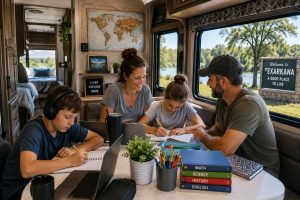
August hits full-time RV families with kids a little differently than it hits everyone else. There’s no first-day-of-school photo on a driveway, no new backpack shopping trip to a specific store you’ve been going to since kindergarten — but there is still a real shift in rhythm that the whole family feels, and figuring out how to handle it well is one of the genuine, ongoing puzzles of full-time RV life with kids.
Why August Still Matters Even Without a School Building
Even families who’ve built their entire education approach around the flexibility of the road tend to feel a pull toward more structure in August, for a few genuine reasons. Extended family, co-op groups, and any local community connections a family maintains often shift back into a school-year rhythm around this time, and staying loosely in sync with that broader calendar makes coordinating with grandparents, cousins, or homeschool co-op friends considerably easier than running on a completely independent schedule year-round.
There’s also a practical curriculum reality: many families using a structured curriculum, whether a formal accredited program or a self-directed one they’ve built themselves, naturally think in terms of an academic year that starts sometime in August or September, simply because most educational materials and grade-level benchmarks are built around that traditional calendar. Working with that structure rather than against it tends to be the path of least resistance for a lot of families.
Building a Roadschool Routine During a Texarkana Stay
A longer stay in one location, like a multi-week or monthly stint at an RV park, is exactly the kind of stability that makes settling into a fresh academic routine actually workable. Rather than trying to establish new school habits while also driving to a new location every few days, a family who’s decided to slow down and stay put for a while in Texarkana gets the consistency that makes routine-building genuinely possible.
“The families who handle this well aren’t the ones with the most elaborate system — they’re the ones who pick a stay long enough to actually settle into a rhythm before moving on again. Trying to start a new school year while also town-hopping every four days is a recipe for nobody getting anything done. Slow down for August specifically, and the whole thing gets easier.”
Setting Up a Workable Learning Space
Even in a smaller RV, designating a specific spot — a table that becomes “school” during certain hours, a particular cushion or chair that’s the reading spot — helps kids mentally shift into learning mode, the same psychological trick that a classroom does for kids in a traditional school. This doesn’t require a major renovation or a dedicated room; it just requires consistency in where and when the learning happens.
Internet and Connectivity for Online Curriculum
For families using any online curriculum component, virtual co-op classes, or video-based instruction, reliable internet access becomes a genuine daily-life necessity rather than a nice-to-have. Confirming your RV site’s Wi-Fi capability, or having a solid cellular hotspot backup plan, before committing to a longer academic-focused stay avoids the frustration of unreliable connectivity interrupting a curriculum that depends on it. A longer, settled stay specifically supports this better than constant movement does, since you’re not re-establishing connectivity at a new location every few days during the exact stretch when consistent access matters most.
Understanding Homeschool Requirements Across State Lines
One of the genuinely important, easy-to-overlook pieces of full-time RV homeschooling is that legal homeschool requirements vary significantly by state, and full-time RV families need to understand the requirements of whichever state they claim as their legal domicile or residency, not necessarily the state they’re physically parked in at any given moment. Requirements can include specific notification filings, record-keeping standards, testing or assessment requirements, and other compliance details that differ meaningfully from state to state.
Because this varies so much and carries real legal weight, checking your specific state’s current homeschool requirements directly — through your state’s department of education or a well-established homeschool legal defense organization — rather than relying on general advice from other RVing families, is the responsible approach. What’s true for a family domiciled in one state may not apply at all to a family domiciled in another.
Making the Most of a Texarkana Stay for Learning
One of the specific advantages of roadschooling is turning the local area itself into curriculum material rather than treating location as incidental to the “real” schoolwork. Texarkana’s own history — straddling the Texas-Arkansas state line, with the well-known post office building sitting directly on the border — gives families a genuinely interesting local history lesson that a textbook alone can’t replicate. Regional museums, the area’s Ark-La-Tex geography, and nearby natural destinations like Wright Patman Lake all offer real, hands-on learning opportunities that fit naturally into a roadschooling approach without requiring a special field-trip day carved out separately from “real” school time.
Settling In for a Longer Stay
For families specifically planning an extended Texarkana stay around the back-to-school season, the full-time RV living in Texarkana guide covers the broader practical picture of settling into the area as a longer-term base, beyond just the schooling piece specifically — mail, local services, and the general rhythm of extended RV living in the area.
Understanding the rate structure for a longer stay matters directly for families budgeting an academic-year-length or multi-month commitment rather than a short vacation stop. Monthly rates typically offer meaningfully better value than booking the same span of nights individually, which matters for a family settling in for a genuine chunk of the school year rather than passing through for a few days.
Why August still matters: staying loosely in sync with the traditional school calendar helps coordinate with extended family, co-ops, and curriculum materials built around an academic year.
Settling in helps: a longer stay (monthly/multi-week) makes establishing a real routine far easier than trying to start fresh while also relocating frequently.
Learning space: a consistent spot/table/chair for “school time” helps kids shift into learning mode, even in a small RV.
Internet: confirm site Wi-Fi and have a cellular hotspot backup if using online curriculum — a settled stay supports reliable connectivity better than constant movement.
Legal requirements: vary by state — follow the requirements of your legal domicile state, not the state you’re physically parked in. Check directly with your state’s education department or a homeschool legal organization.
Local learning: Texarkana’s Texas-Arkansas border history, regional museums, and nearby destinations like Wright Patman Lake make genuine roadschooling material.
For families planning an extended stay around the school year, current rates and site information are at the RV Park Texarkana pricing page. The RV Park Texarkana photo gallery gives a sense of the property for families evaluating whether it’s the right settled-in base for their situation. And for booking a longer Texarkana stay, RV Park Texarkana is the starting point.
Frequently Asked Questions
How do full-time RV families handle back-to-school without a fixed school?
Most full-time RVing families with kids use homeschooling or roadschooling — an approach that incorporates travel and hands-on, location-based learning alongside more traditional academic work. Even without a physical school building, many families still treat August as a meaningful reset point, since curriculum materials, extended family schedules, and homeschool co-op groups often follow the traditional academic-year calendar. Settling into a longer stay at one location during this period, rather than continuing frequent travel, tends to make establishing a fresh routine considerably easier.
What are the legal requirements for homeschooling while full-time RVing?
Legal homeschool requirements vary significantly by state, and full-time RV families need to follow the requirements of whichever state they claim as their legal domicile or residency, not necessarily the state they’re physically parked in at any given time. Requirements can include notification filings, record-keeping standards, and testing or assessment requirements that differ meaningfully between states. Checking your specific state’s current requirements directly through the state’s department of education or an established homeschool legal defense organization is the responsible approach, since general advice from other RVing families may not apply to your specific domicile state.
Is reliable internet important for RV homeschooling?
Yes, particularly for families using any online curriculum component, virtual classes, or video-based instruction, where reliable internet becomes a genuine daily necessity. Confirming an RV site’s Wi-Fi capability, or having a solid cellular hotspot as backup, before committing to a longer academic-focused stay helps avoid connectivity interruptions during instructional time. A longer, settled stay generally supports more reliable connectivity than constant relocation, since the family isn’t re-establishing internet access at a new location every few days during a period when consistent access matters most.
What is roadschooling and how is it different from homeschooling?
Roadschooling is a term used within the full-time RV community to describe education that incorporates travel and location-based, hands-on learning experiences alongside more traditional academic instruction. It’s often considered a specific style or approach within the broader category of homeschooling, emphasizing real-world learning opportunities from the places a family visits — history, geography, science, and cultural learning drawn directly from travel — combined with structured academic work in core subjects.
Are monthly RV rates better for a family settling in for an extended school-year stay?
Generally, yes. Monthly rate structures typically offer meaningfully better value than booking the same span of nights individually at the standard nightly rate, which matters directly for families planning an extended, academic-year-length or multi-month stay rather than a short vacation visit. Confirming current monthly rate structures directly with the specific RV park is worthwhile for accurate budgeting, since rate structures and any long-term stay discounts can vary by property and season.
What local learning opportunities does Texarkana offer for roadschooling families?
Texarkana’s location straddling the Texas-Arkansas state line, including the well-known post office building situated directly on the border, offers a genuinely interesting local history and geography lesson for roadschooling families. Regional museums, the broader Ark-La-Tex area’s geography, and nearby natural destinations like Wright Patman Lake all provide real, hands-on learning material that fits naturally into a roadschooling approach, turning the local area itself into curriculum content rather than treating it as separate from the family’s academic work.