
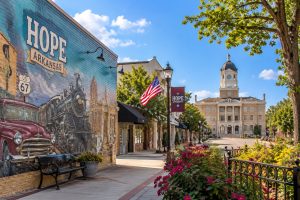
Hope is one of those small Southern towns that has a lot more going on than its size suggests — a former president’s birthplace, a festival that draws tens of thousands of people every August, and the kind of genuine Arkansas character that makes a day trip feel like you actually went somewhere.
The city of about 9,000 people is best known nationally as the birthplace of Bill Clinton, 42nd President of the United States, and as the home of one of the South’s most famous agricultural festivals. But the Hope, Arkansas attractions picture is more complete than either of those headline items suggests — there’s a historic downtown, a genuine regional food culture, and the specific texture of a Southwest Arkansas small town that rewards a few hours of unhurried exploration.
This guide covers the full day trip from Texarkana to Hope — the historic sites, the annual events, the food, and what to actually do with four to six hours in town.
The Drive: 40 Miles of I-30
The drive from Texarkana to Hope is straightforward — east on I-30, about 40 to 45 minutes depending on traffic. This is one of those drives that isn’t particularly scenic but isn’t particularly long either, which makes Hope the kind of day trip you actually do rather than just keep meaning to do. There’s no logistics overhead. You leave after breakfast, you’re there by mid-morning.
If you want to make the drive itself interesting, the US-67 old highway parallels I-30 through parts of the corridor and passes through some of the small communities between Texarkana and Hope that preserve more of the pre-interstate Arkansas road culture. Not dramatically different, but more interesting than a pure interstate run if you have the time and inclination for back-road travel.
The Clinton Birthplace: Hope’s National Historic Site
The most visited Hope AR attraction is the President William Jefferson Clinton Birthplace Home, a National Historic Site managed by the National Park Service. The Victorian-era house at 117 South Hervey Street is where Clinton was born on August 19, 1946, and where he lived until the age of four before moving to Hot Springs, Arkansas.
The site is a genuine piece of American political history in an intimate setting — a modest Victorian house in a residential neighborhood, restored to its mid-1940s appearance and furnished to reflect the period. The NPS interpretation covers Clinton’s early childhood in Hope, the influence of his mother Virginia and his grandparents (who raised him in this house during his earliest years), and the broader context of post-World War II small-town Arkansas life.
Admission is free — it’s a National Park Service site. Hours are typically 9 a.m. to 4:30 p.m. Tuesday through Saturday, though confirming current hours at nps.gov before visiting is advisable. The tour is self-guided with NPS ranger interpretation available, and the adjacent visitor center has exhibits on Clinton’s Hope years and Arkansas heritage more broadly. Plan an hour for a proper visit, including time to talk with the ranger staff if they’re present.
“The Clinton birthplace is the kind of historic site that’s better than it sounds — not a hagiographic presidential library, just a small house with a real story from an ordinary Arkansas family.”
Historic Downtown Hope: What’s Worth Seeing
Downtown Hope has the character of a Southwest Arkansas county seat that’s been through the economic cycles of the 20th century — some buildings thriving, others waiting for their next chapter, the whole streetscape telling an honest story about a small Southern city that’s neither artificially preserved nor abandoned.
The Hempstead County Courthouse, built in 1939, is one of the finer Art Deco courthouses in Arkansas — a style that fits the era of Hope’s peak prosperity in the post-railroad, pre-interstate period. The downtown commercial district has several buildings that date to the late 19th and early 20th century, when Hope was a significant railroad junction and commercial center for Southwest Arkansas.
The Hope Visitor Center in the historic downtown depot is a useful first stop — the old railroad depot has been preserved and converted to visitor services, and the staff can provide current information about what’s open and what events are happening during your visit. The depot itself is worth seeing as a piece of railroad heritage in a town whose entire commercial development was shaped by the railroad’s arrival in the 1870s.
The Hope Watermelon Festival: Plan Around This
The Hope Watermelon Festival is the event that most people associate with the city, and with good reason — it’s one of the longest-running agricultural festivals in Arkansas and one of the more genuinely fun summer events in the Texarkana region. The festival runs annually in mid-August, typically drawing 50,000 to 75,000 visitors over the course of several days.
Hope, Arkansas holds a place in agricultural history as the home of some of the largest watermelons ever grown. In 1925, a Hope farmer named I.N. Bright grew a watermelon weighing 136 pounds — a record that set the town’s reputation for enormous melons. While the seed genetics used in the modern festival circuit are different from the heirloom varieties that produced those giants, the tradition of giant-melon growing is still alive in Hempstead County, and the festival’s watermelon judging competition draws serious growers from across the region.
The festival runs Friday through Sunday in August and includes live music, a carnival, food vendors, a parade, crafts, and the watermelon competitions — seed-spitting contests, melon-eating contests, largest melon competitions. The atmosphere is unapologetically county-fair and the event attracts the full regional population from Texarkana west to Little Rock. If your Texarkana stay overlaps with the festival dates, this is the reason to make the drive. If it doesn’t, the downtown and historic sites are worth the trip on their own.
Food in Hope: Eating Like a Local
Hope’s food scene reflects its character as a working Southwest Arkansas county seat — not destination dining by any measure, but honest regional cooking that gives you a more accurate impression of the place than a franchise meal would. The local diners and family restaurants that have served the Hope community for generations are worth seeking out over the highway commercial strip options, even if finding them takes a little more navigation.
Sweet potato pie is a local specialty that shows up at various food operations around Hempstead County — sweet potatoes have been a major agricultural product of the region for generations, and the pie version that local cooks produce is worth going out of your way for if you encounter it. Hope’s local meat-and-three and Southern plate lunch culture gives you access to the collard greens, black-eyed peas, cornbread, and slow-cooked pork that characterizes traditional Arkansas country cooking at its best.
What to Look For in Town
Before your visit, checking current open restaurants and local dining reviews on Google Maps gives you the most accurate picture of what’s currently operating — small-town restaurant situations change faster than any guide can keep up with. The historic downtown area and the neighborhoods adjacent to the Clinton birthplace tend to have better independent food options than the I-30 commercial corridor, which is dominated by national chains.
8:30 a.m. — Depart Texarkana east on I-30. 9:15 a.m. — Arrive Hope, park near downtown.
9:30 a.m. — Visitor Center at the historic depot, pick up current info.
10:00 a.m. — Clinton Birthplace Home National Historic Site (allow 1 hour, check hours at nps.gov).
11:30 a.m. — Walk the historic downtown, courthouse, commercial district.
12:30 p.m. — Lunch at a local spot.
2:00 p.m. — Return to Texarkana or continue east for a longer day out.
August timing: Add the Watermelon Festival and plan for crowds, parking challenges, and a full day rather than a half-day.
For RV travelers and campers based near Hope or considering a stay in the area, the RV park near Hope, AR gives you accommodation options close enough to explore Hope over multiple days rather than just a single day trip pass. And for everything about RV Park Texarkana as a home base for day trips throughout the Texarkana-Hope-Southwest Arkansas corridor, RV Park Texarkana is the starting point.
Frequently Asked Questions
How far is Hope, Arkansas from Texarkana?
Hope is approximately 40 miles east of Texarkana via I-30, with a typical drive time of 40 to 45 minutes. The route is a straightforward interstate drive with no significant navigation challenges. Hope sits in Hempstead County in southwestern Arkansas, making it one of the most accessible day trip destinations from Texarkana — east enough to feel like a genuine destination, close enough to leave after breakfast and return comfortably for an evening meal.
What is the Clinton Birthplace in Hope, Arkansas?
The President William Jefferson Clinton Birthplace Home is a National Historic Site managed by the National Park Service at 117 South Hervey Street in Hope. It preserves the Victorian-era house where Bill Clinton was born on August 19, 1946, and lived until age four. The home is restored to its mid-1940s appearance and furnishings, with interpretation covering Clinton’s Hope years and the broader context of post-World War II Southwest Arkansas. Admission is free. Hours are typically Tuesday through Saturday, 9 a.m. to 4:30 p.m. — confirm current hours at nps.gov before visiting as schedules can change seasonally.
When is the Hope Watermelon Festival?
The Hope Watermelon Festival runs annually in mid-August, typically over a Friday through Sunday weekend. Exact dates change from year to year — check the City of Hope’s official website or the festival’s social media for current year dates. The festival draws an estimated 50,000 to 75,000 visitors over the event weekend and includes live music, carnival rides, food vendors, a parade, and watermelon competitions including largest melon judging, seed-spitting, and melon-eating contests. If your Texarkana stay overlaps with the festival, plan for significantly heavier traffic on I-30 and in Hope, and arrive early for parking.
Why is Hope, Arkansas famous for watermelons?
Hope developed its watermelon reputation through the Hempstead County soil conditions and the growing tradition of local farmers who cultivated giant melon varieties. The agricultural fame peaked with I.N. Bright’s 1925 record watermelon weighing 136 pounds, establishing the town’s association with the crop. The sandy loam soils of southwestern Arkansas provide particularly favorable conditions for large melon production, and Hope growers continued developing the giant-melon tradition through the 20th century. The annual Watermelon Festival, running for decades, institutionalized this agricultural heritage into one of Arkansas’s most attended regional festivals.
Is Hope, Arkansas worth a day trip from Texarkana?
Yes, particularly if you time it for the Watermelon Festival or have an interest in American political history through the Clinton birthplace. Even outside the festival period, Hope offers a half-day of genuine interest — the National Historic Site, the historic downtown with its Art Deco courthouse and railroad depot, and the Southwest Arkansas local food culture that gives a more textured impression of the region than staying exclusively in the Texarkana commercial corridor. The 40-minute drive makes the logistics simple enough that it’s a realistic addition to any Texarkana stay rather than a dedicated expedition.
What else is there to do in Hope beyond the Clinton birthplace?
Beyond the birthplace, Hope’s attractions include the historic downtown commercial district with its late 19th and early 20th century architecture, the Hempstead County Courthouse (a notable 1939 Art Deco building), the visitor center in the preserved railroad depot, local dining with regional Arkansas food traditions, and the annual Watermelon Festival in August. The surrounding Hempstead County landscape also rewards driving — the rural southwestern Arkansas agricultural landscape between Hope and the Louisiana border has a distinct character that’s worth exploring on a slower route back to Texarkana rather than the direct I-30 return.