
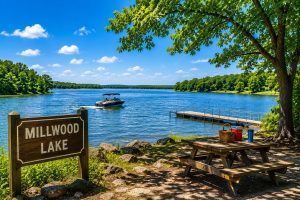
About 30 miles northeast of Texarkana sits one of the most underrated lakes in Arkansas — and one of the best reasons to leave the campsite for a day. Millwood Lake is worth the drive. More than once.
For RV travelers and campers based in the Texarkana area, a Millwood Lake day trip is one of the most rewarding ways to spend a full day in this part of the country. This guide covers everything you need to make the most of it — the drive, the fishing, the wildlife, and the practical information that makes the difference between a great day and a logistically complicated one.
The Drive from Texarkana
Millwood Lake is approximately 30 miles northeast of Texarkana, in Little River County just south of the town of Ashdown. The most direct route takes you northeast on US-71 from Texarkana toward Ashdown, then east toward the lake via Arkansas Highway 32. Total drive time is typically 40 to 50 minutes, depending on your starting point in the Texarkana area.
The drive itself is worth a comment — this is southwest Arkansas Piney Woods country, and the route through Little River County has the quality of deep rural Arkansas that you don’t get on the main interstate corridors. Pine trees pressing close to the road, bottom land along the creek drainages, the particular green density that this part of the state maintains through most of the year. It’s a pleasant drive to a worthwhile destination, which is a combination that every day trip should aspire to.
“Millwood Lake is the kind of place that fishermen guard a little. Once you go, you understand why they don’t tell everybody.”
Millwood Lake Arkansas: The Lake Itself
Millwood Lake in Arkansas covers approximately 29,500 acres — a substantial body of water created by the Army Corps of Engineers in 1973 by damming the Little River. The impoundment flooded a large area of bottomland hardwood forest, and that submerged timber is still there, decades later, providing the structural habitat that has made this lake a genuine fishing destination.
The lake’s character is shaped by that flooded timber. The shallow to mid-depth zones of the lake are threaded with standing dead timber, submerged logs, and the kind of layered bottom structure that fish — especially largemouth bass and crappie — orient to year-round. This is not a featureless, open-water lake. It’s a lake that rewards anglers who learn to read timber structure and work it methodically.
Water clarity at Millwood is typically moderate — not gin-clear, not impossibly murky. The somewhat stained water characteristic of bottomland impoundments in this region actually works in the angler’s favor, making fish less wary and more willing to commit to lures at close range. This is a productive water body for anglers at almost every skill level, which is one of the reasons it’s such a satisfying day trip.
Millwood Lake Fishing: What to Target and How
Millwood Lake fishing is dominated by four species that make it worth the trip for serious and casual anglers alike.
Largemouth Bass
Millwood’s largemouth bass population is the lake’s signature fishery. The combination of extensive flooded timber, productive shallow flats, and the warm bottomland water temperature profile creates bass fishing conditions that Arkansas Game and Fish Commission surveys have consistently ranked among the best in the state. Bass in the 3 to 5 pound range are common, and the lake produces fish over 7 pounds with regularity.
Spring (March through May) is the peak season — pre-spawn and spawn patterns bring large fish into shallow timber and flats where they’re aggressive and accessible. Early morning topwater around timber edges in spring is one of those fishing experiences you remember specifically. Fall is the second-best season. Summer fishing is productive early and late but requires working deeper timber during midday. Texas-rigged soft plastics, spinnerbaits, and shallow crankbaits around timber cover are the most consistently effective approaches year-round.
Crappie
Millwood produces large crappie — fish in the 1.5 to 2 pound range are common during spring spawn when fish concentrate in shallow timber near the bank. Small tube jigs and live minnows around submerged trees produce consistent action from mid-March through early May. Post-spawn crappie pull back to slightly deeper timber and remain catchable on small jigs throughout the summer for anglers willing to slow down and fish the structure methodically.
Catfish
Blue catfish and flathead catfish are present in Millwood and are targets for evening and overnight fishing. Cut shad, chicken liver, and large live baits for flatheads produce consistent action. The lake’s extensive shallow areas warm quickly in summer, concentrating catfish activity in the channels and deeper timber during the day and spreading them into the shallows at night.
White Bass and Hybrids
White bass runs in spring, when fish push up toward the dam and into tributary areas during spawning, provide short-window but high-action fishing on small spinners and jigs. Hybrid striped bass — a cross of white bass and striped bass stocked by Arkansas Game and Fish — add a larger, harder-fighting species to the mix and are catchable through the year around structure.
Wildlife at Millwood Lake
Fishing aside, Millwood Lake is one of the better wildlife watching destinations in southwest Arkansas, and this dimension of the day trip deserves its own treatment.
The lake and surrounding Millwood State Park and Corps of Engineers lands support one of the densest concentrations of bald eagles in Arkansas during the winter months — typically December through February. The combination of large, open water and abundant fish draws eagles from a wide area, and it’s not unusual to see a dozen or more birds in the large trees along the shoreline on a winter morning. This alone makes a Millwood winter day trip worth planning.
Year-round, the lake’s extensive wetland margins support great blue herons, great egrets, various duck species, osprey, and the full range of waterbirds associated with bottomland impoundments. Deer are common along the wooded margins in the early morning. Wild turkey are present in the adjacent timber. For birders and wildlife watchers, Millwood is a genuinely productive site that doesn’t require serious commitment — you’ll see wildlife simply by being at the lake, without dedicated birding effort.
Millwood State Park and Day Use Areas
Millwood State Park on the north shore provides the primary day-use infrastructure for lake visitors — boat ramps, picnic areas, beach access, and the basic facilities that make a full day at the lake comfortable rather than purely rustic. The park charges a day-use fee for vehicle entry; the current rate is accessible on the Arkansas State Parks website and subject to change, so checking before you arrive avoids any surprise at the gate.
The Corps of Engineers also maintains several day-use areas and boat ramps around the lake perimeter, some with picnic facilities and some more basic. For anglers who don’t need full park facilities, the Corps access points give boat ramp access without the park entry fee.
Staying Near Millwood Lake
For RV travelers who want more than a single day at Millwood — and after a first visit, most people do — the option to base yourself near the lake rather than driving from Texarkana each time makes the experience considerably richer.
The RV park near Millwood Lake gives you the combination of lake proximity and campground infrastructure that makes multi-day fishing and outdoor recreation genuinely convenient. Waking up near the lake, on the water early without the 45-minute pre-dawn drive, changes the whole experience. The first few hours of morning light are the best hours at Millwood, and being close enough to use them is worth a lot.
For travelers who want more context on the full RV experience in the Texarkana area and the range of what this region offers for outdoor recreation and day trips, the RVing lifestyle and regional guide covers the area’s broader picture — Millwood is one excellent option among several.
Frequently Asked Questions
How far is Millwood Lake from Texarkana?
Millwood Lake is approximately 30 miles northeast of Texarkana via US-71 north and Arkansas Highway 32 east, with a typical drive time of 40 to 50 minutes. The route passes through the Piney Woods of southwest Arkansas and is a scenic, straightforward drive without significant navigation challenges. The most common access point for first-time visitors is Millwood State Park on the lake’s north shore, which is well-signed from the main approach roads.
What fish species are in Millwood Lake?
The primary sport fish in Millwood Lake are largemouth bass (consistently ranked among the best in Arkansas), crappie (known for above-average size), blue catfish and flathead catfish, white bass, and hybrid striped bass (stocked by Arkansas Game and Fish Commission). The lake’s flooded timber habitat is particularly favorable for largemouth bass and crappie, which use the structural cover year-round. Spring is the peak season for most species, with bass and crappie both spawning in the shallow timber areas.
Do I need an Arkansas fishing license to fish Millwood Lake?
Yes. An Arkansas fishing license is required for all anglers age 16 and older. Arkansas fishing licenses are available at Walmart and sporting goods retailers in Texarkana and the surrounding area, through the Arkansas Game and Fish Commission website at agfc.com, and through the AGFC mobile app. One-day, three-day, and annual license options are available — for a single day trip, the one-day license is the most economical option if you don’t already have an annual license. Non-residents pay higher rates than Arkansas residents. Purchase before your trip rather than counting on access at the lake — service options near the lake are limited.
What is the best time of year to fish Millwood Lake?
Spring (March through May) is the best overall season — largemouth bass pre-spawn and spawn activity brings large fish into shallow timber and flats, crappie concentrate near the bank during their spawn, and white bass runs in early spring provide exciting action. Fall (September through November) is the second-best window, with actively feeding fish preparing for winter. Summer fishing is productive in the early morning and evening windows. Winter fishing is slower but notable for the exceptional bald eagle viewing that makes the lake worth visiting even when the fish aren’t biting.
Are there boat rentals at Millwood Lake?
Boat rental availability at Millwood Lake is limited compared to more commercially developed lakes and changes over time with local business operations. Checking with Millwood State Park directly about current rental availability before your trip is the most accurate approach — what was available during a prior visit may not be available on a subsequent one. Anglers who bring their own boats have the most consistent access to the lake’s productive fishing areas. The state park maintains well-maintained ramps that accommodate most trailer configurations.
Is Millwood Lake good for bald eagle watching?
Yes, and it’s one of the better bald eagle viewing sites in Arkansas during the winter months (December through February). The combination of large, open water, abundant fish, and the trees along the shoreline creates optimal eagle habitat, and concentrations of a dozen or more birds are not unusual on winter mornings during peak periods. The state park’s day-use areas and the accessible shoreline provide good viewing positions without requiring a boat. Binoculars significantly improve the experience. For wildlife-oriented visitors, a winter Millwood Lake day trip specifically for eagle watching is a genuinely outstanding experience that most Arkansas residents have never had.