
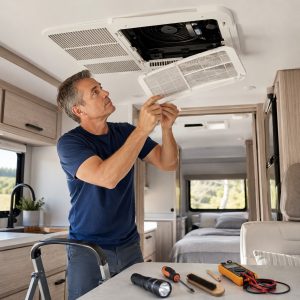
An RV AC that suddenly stops cooling on a 98-degree Texarkana afternoon is one of the more stressful things that can happen mid-trip, and the instinct to call a technician immediately is completely understandable. But a genuinely large share of RV AC problems trace back to a handful of specific, fixable issues that don’t require a service call at all — knowing what to check first can save you both the wait time and the expense.
Most RV rooftop air conditioners are genuinely reliable pieces of equipment, but they take real abuse — vibration from driving, temperature extremes, dust and debris, and long stretches of continuous operation during a hot summer stay. When something goes wrong, working through a logical troubleshooting sequence, starting with the simplest and most common issues, resolves the problem more often than people expect.
First: Confirm It’s Actually an AC Problem
Check Your Power SourceBefore assuming your AC unit itself has failed, confirm you’re actually getting adequate power to it. If you’re on shore power, check that the pedestal connection is secure and that the specific breaker for your AC circuit hasn’t tripped, both at your RV’s breaker panel and at the campground pedestal. If you’re running on a generator, confirm it’s actually producing power at the expected output and hasn’t bogged down under the AC’s startup load, which draws significantly more power than steady-state running.
Verify the Thermostat SettingsThis sounds almost too simple to mention, but a surprising number of “AC isn’t cooling” situations trace back to a thermostat set to fan-only mode, a cooling setpoint that’s actually higher than the current interior temperature, or batteries in a wireless thermostat that have died. Confirm the thermostat is actually set to cooling mode with a setpoint below the current room temperature before moving on to anything more involved.
The AC Runs But Isn’t Cooling: Common Causes
Dirty or Clogged Air Filters
A dirty air filter is genuinely one of the most common causes of reduced AC cooling performance, and it’s also one of the easiest fixes. A clogged filter restricts airflow across the evaporator coil, which reduces the unit’s ability to actually cool the air passing through it, sometimes dramatically. Most RV rooftop units have easily accessible filters behind the interior ceiling assembly — remove them, check for visible dust and debris buildup, and clean or replace as needed. During heavy summer use, checking filters every couple of weeks rather than waiting for a problem to develop is a reasonable maintenance habit.
Blocked or Restricted Airflow at the Unit
Check that nothing is blocking the interior vents or the return air grille, since restricted airflow anywhere in the system reduces cooling performance the same way a dirty filter does. On the roof, visually inspect (safely, from the ground with binoculars if you’re not comfortable getting on the roof) for any obvious debris, leaves, or obstructions around the unit’s exterior housing that could be restricting airflow to the condenser coil.
Dirty Condenser Coils
The condenser coils on the roof-mounted portion of your AC unit can accumulate dirt, dust, and debris over time, particularly after highway driving or a dusty campground stay, and this buildup reduces the unit’s ability to release heat effectively, directly impacting cooling performance. If you’re comfortable and confident accessing your roof safely, gently cleaning the condenser coils with a soft brush and coil cleaner (available at most hardware or RV supply stores) following your specific unit’s manual can restore meaningfully better performance. If you’re not comfortable with this step, it’s a reasonable one to leave to a technician during your next service visit.
“Probably eight times out of ten when someone calls us about an AC that’s ‘barely blowing cool air,’ it turns out to be a dirty filter or dirty condenser coils. It’s not glamorous, but it’s also not complicated — a filter you can clean yourself in five minutes solves more AC problems than people expect.”
The AC Won’t Turn On At All
Check the Circuit Breaker
If the unit won’t power on at all, check your RV’s breaker panel for a tripped breaker on the AC circuit — this is common, particularly if the unit was trying to start alongside other significant electrical loads. Reset the breaker and try again, but if it trips repeatedly, that’s a sign of a deeper electrical issue that warrants professional diagnosis rather than repeatedly resetting the same breaker.
Try a Manual Reset
Many RV AC units have a specific reset procedure, often involving turning the unit off, waiting a set period (commonly around 3 to 5 minutes, though this varies by manufacturer), and then turning it back on. This reset can clear a temporary fault or protective shutdown, particularly one triggered by a brief power fluctuation. Consult your specific unit’s manual for the exact reset procedure, since it varies between manufacturers and models.
Check for a Tripped Thermal Overload
Many AC units have a built-in thermal overload protection that shuts the unit down if it’s overheating internally, often due to restricted airflow or an electrical issue. If your unit shut down and won’t restart immediately, letting it sit powered off for 15 to 30 minutes to fully cool down before attempting a restart can allow this protection to reset on its own.
The AC Is Making Unusual Noise
A rattling or buzzing noise sometimes indicates a loose panel, shroud, or mounting hardware rather than an internal mechanical problem — checking that the exterior shroud and any visible mounting bolts are properly tightened is a reasonable first check. A squealing noise can sometimes indicate a fan motor bearing issue, which generally isn’t a DIY fix and warrants professional attention. Any grinding or significant mechanical noise beyond a simple rattle is a signal to shut the unit down and have it professionally inspected rather than continuing to run it.
When to Stop Troubleshooting and Call a Technician
Refrigerant-related issues (the unit runs but produces no cold air at all despite clean filters and coils), significant electrical problems beyond a simple tripped breaker, persistent unusual noises beyond a loose panel, or any situation where you’re not comfortable safely accessing or working on the unit are all reasonable points to stop DIY troubleshooting and call a professional. Attempting repairs beyond your comfort level, particularly involving refrigerant systems (which require EPA-certified handling) or significant electrical work, isn’t worth the risk of causing further damage or a safety hazard.
If your AC issue develops into something requiring urgent attention during a Texarkana stay — particularly during genuine summer heat — the RV emergencies guide for Texarkana travelers covers the broader picture of handling an urgent RV issue while on the road, including when and how to find local service help quickly.
Staying Comfortable While You Sort It Out
If your AC is down and you’re waiting on parts or a technician appointment, managing the interior heat in the meantime matters. Close blinds and window coverings on the sun-facing side, use any available fans to improve air circulation, and if the situation extends beyond a short window, considering a temporary move to a cabin accommodation while your AC gets sorted out is a reasonable option worth asking about. The cabin, RV, and tent summer camping comparison guide covers the tradeoffs between accommodation types if you’re weighing that option during a hot stretch.
First checks: power source (breaker, pedestal, generator output), thermostat settings and mode, dead thermostat batteries.
Running but not cooling: dirty air filter (check every 2 weeks in heavy summer use), blocked interior/exterior airflow, dirty condenser coils.
Won’t turn on: check breaker (don’t repeatedly reset if it keeps tripping), try manufacturer’s manual reset procedure, let thermal overload cool down 15-30 min before restart.
Unusual noise: rattling = check loose panel/mounting hardware. Squealing/grinding = stop and call a professional.
Call a technician for: refrigerant issues, electrical problems beyond a simple breaker trip, persistent unusual noise, anything beyond your comfort/safety level.
Always disconnect power before opening any panel or working near electrical components.
For guests planning a summer Texarkana stay, current rates and site information are at the RV Park Texarkana pricing page. And for booking any Texarkana stay, RV Park Texarkana is the starting point — the office can also point you toward local RV service options if your troubleshooting doesn’t resolve the issue.
Frequently Asked Questions
Why is my RV air conditioner running but not cooling?
The most common causes are a dirty or clogged air filter restricting airflow across the evaporator coil, blocked airflow at the interior vents or exterior condenser unit, or dirty condenser coils reducing the unit’s ability to release heat effectively. Checking and cleaning the air filter is the easiest first step and resolves a significant share of “running but not cooling” complaints. If cleaning the filter and checking for obvious airflow obstructions doesn’t resolve the issue, dirty condenser coils or a refrigerant-related problem may be involved, with the latter requiring professional service.
How do I reset my RV air conditioner?
Most RV AC units have a specific reset procedure involving turning the unit off, waiting a set period (commonly 3 to 5 minutes, though this varies by manufacturer), and then turning it back on. This can clear a temporary fault or protective shutdown triggered by a brief power fluctuation. Consulting your specific unit’s owner’s manual for the exact reset procedure is recommended, since the process can vary between manufacturers and models. If your unit has a thermal overload protection feature and shut down due to overheating, letting it sit powered off for 15 to 30 minutes before attempting a restart may also allow the protection to reset.
How often should I clean my RV air conditioner’s filter?
During heavy summer use, checking and cleaning your RV AC’s air filter every couple of weeks is a reasonable maintenance habit, since a dirty filter is one of the most common causes of reduced cooling performance. Most RV rooftop units have easily accessible filters behind the interior ceiling assembly that can be removed, checked for dust and debris buildup, and cleaned or replaced without professional assistance. Regular filter maintenance is one of the simplest and most effective preventive steps for maintaining good AC performance throughout a hot summer season.
What should I check if my RV AC won’t turn on at all?
First, check your RV’s breaker panel for a tripped breaker on the AC circuit, which is a common and easily fixable cause of an AC unit that won’t power on. Reset the breaker and try again, but if it trips repeatedly, this indicates a deeper electrical issue that requires professional diagnosis rather than continuing to reset the same breaker. Also confirm your thermostat is properly set to cooling mode with a setpoint below the current room temperature, and check that any wireless thermostat batteries aren’t dead, since these simple issues are sometimes mistaken for a unit failure.
Is it safe to clean my RV AC’s condenser coils myself?
If you’re comfortable and confident safely accessing your RV’s roof, gently cleaning the condenser coils with a soft brush and a coil cleaner product formulated for AC units, following your specific unit’s manual instructions, is a task many RV owners handle themselves. However, if you’re not comfortable with roof access or unsure about the proper cleaning process, this is a reasonable task to leave to a professional technician during a routine service visit rather than risking damage to the unit or a fall from the roof.
What RV AC problems require a professional technician rather than DIY troubleshooting?
Refrigerant-related issues (the unit runs but produces no cold air despite clean filters and coils), significant electrical problems beyond a simple tripped breaker, persistent unusual noises beyond a loose panel or mounting hardware, and any situation where you’re not comfortable safely accessing or working on the unit all warrant professional service rather than continued DIY troubleshooting. Refrigerant systems specifically require EPA-certified handling and aren’t a do-it-yourself repair. Attempting repairs beyond your comfort level risks causing further damage or creating a safety hazard.