
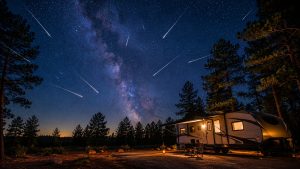
The 2026 Perseids are shaping up to be one of the genuinely best years to watch this shower in recent memory — the peak falls exactly on a new moon, meaning zero moonlight competing with the meteors, and NASA’s own guidance is refreshingly simple: no telescope required, no special equipment, just a dark-enough sky and a bit of patience. And you don’t need to drive anywhere special to get that dark sky. Your own RV site, with the campground’s lights dimmed for the night, might genuinely be the best seat around.
2026 Peak Dates and Why This Year Is Special
The Perseids are active from mid-July through late August, but the shower peaks overnight on August 12 into the early morning hours of August 13, 2026. What makes this specific year genuinely exceptional is the moon phase: the peak coincides almost exactly with a new moon, meaning there will be virtually no moonlight washing out the fainter meteors. A bright moon is normally the single biggest obstacle to a good meteor shower view, since it lights up the sky and drowns out all but the brightest streaks — 2026 removes that obstacle almost entirely.
Adding to the rarity, August 12, 2026 also hosts a total solar eclipse, marking the first time in the 21st century that a Perseid peak and a total solar eclipse have coincided on the same date. The eclipse’s path of totality doesn’t cross the continental United States, so Texarkana won’t see a total eclipse, but the coincidence is a genuinely notable piece of 2026 astronomical trivia even for viewers who’ll only be watching the meteors that night.
“You get a year like this maybe once every decade or so — a Perseid peak lining up almost perfectly with a new moon. Most years you’re fighting some amount of moonlight. This year, if the sky’s clear, there’s really nothing standing between you and the show except clouds.”
Best Viewing Times
The Perseid radiant — the point in the sky the meteors appear to streak from, located near the constellation Perseus — rises in the late evening and climbs highest in the sky just before dawn. This means the best viewing window is genuinely after midnight through the hours just before sunrise on both August 12 and August 13, rather than early evening, when the radiant hasn’t risen high enough yet for good rates. NASA’s general guidance is to start watching around 11 p.m. local time, when meteor rates begin picking up, and to plan for the bulk of your viewing between midnight and dawn.
Under ideal dark-sky conditions with the radiant high overhead, NASA estimates viewers can see an average of up to 100 meteors per hour during the peak — genuinely one of the higher rates of any annual shower, and a number that occasionally climbs even higher during an outburst year.
Finding the Radiant
To locate the general area meteors will be streaking from, look toward the northeast after 10 p.m. and find Cassiopeia, the distinctive “W” or “M”-shaped constellation. Perseus sits just below it. That said, you don’t need to stare directly at the radiant to see meteors — in fact, meteors near the radiant point have shorter visible trails, so looking generally upward and toward that quadrant of the sky, rather than fixating on one exact spot, gives you the best overall view.
Why Your RV Site Might Genuinely Be the Best Spot
The specific advantage of watching from a Texarkana RV site rather than driving somewhere else comes down to a simple combination: you don’t need a certified dark-sky location to enjoy the Perseids, you just need a reasonably dark sky and an unobstructed view overhead, and a rural or semi-rural RV park setting away from a city center often delivers exactly that without requiring a late-night drive.
Watching from your own site also means you can settle in comfortably for the multi-hour window that good meteor viewing actually requires — a reclining chair, a blanket, and zero need to drive home afterward at 3 a.m. This is a genuinely underrated practical advantage over a drive-out dark-sky location: you can watch as long as you want and simply walk back inside when you’re done or when clouds roll in.
For a broader look at specific stargazing spots around the Texarkana area beyond your own campsite, the night skies in Texarkana guide covers additional nearby options if you want to venture out for an even darker sky on peak night.
Practical Viewing Tips
Give your eyes time to adjust to the dark — meaningful dark adaptation takes about 20 to 30 minutes, and even briefly checking a bright phone screen resets that adjustment. If you need light, use a red-light flashlight or your phone’s night mode rather than a full-brightness screen. Dress for a night outside even in August, since sitting still for hours after midnight can get surprisingly cool, and bring insect repellent given East Texas’s summer bug population.
No telescope or binoculars are needed, and NASA specifically emphasizes this — the Perseids move too fast and cover too much sky for optical aids to help; your unaided eyes, given time to adjust, are the right tool. A wide, unobstructed view of the sky matters more than any equipment, so positioning your chair or blanket somewhere at your site with minimal tree or building overhang overhead is worth doing if your site has that option.
Weather Is the Real Variable
With the moon out of the equation this year, weather becomes the single biggest factor determining whether peak night delivers. Checking the forecast in the days leading up to August 12 and 13, and having a backup night in mind (activity remains strong on the nights immediately before and after the peak, given the new moon conditions extending across that window) gives you flexibility if clouds move in on the exact peak date.
Peak: overnight August 12 into early morning August 13, 2026. Moon: new moon (0% illumination) — ideal dark-sky conditions.
Best viewing window: after midnight through dawn, both Aug 12 and Aug 13. Start watching around 11 p.m.; rates increase as the night goes on.
Expected rate: up to ~100 meteors/hour under ideal dark conditions (NASA estimate).
Radiant location: near constellation Perseus, below Cassiopeia (the “W”/”M” shape), northeast sky after 10 p.m. — but look broadly, not just at the radiant.
No equipment needed: unaided eyes work best. Allow 20-30 min for eye adaptation to darkness. Use red light only if needed.
Backup nights: activity remains strong Aug 11 and Aug 14 under continuing dark-sky conditions if peak night is cloudy.
2026 bonus: peak coincides with a total solar eclipse (not visible as total from Texarkana) — first time this century a Perseid peak and total eclipse have landed on the same date.
For guests planning to be on-site for peak night, current rates and site information are at the RV Park Texarkana pricing page. Guests who’d rather watch from a cabin porch than an RV site can check the cabin accommodations at RV Park Texarkana. For more on the property and what makes it a good stargazing base beyond just this one event, the about RV Park Texarkana page covers the fuller picture. And for booking a site in time for the August 12-13 peak, RV Park Texarkana is the starting point.
Frequently Asked Questions
When is the Perseid meteor shower peak in 2026?
The 2026 Perseid meteor shower peaks overnight on August 12 into the early morning hours of August 13. The best viewing window is after midnight through dawn on both nights, since the radiant (the point in the sky meteors appear to originate from) rises in late evening and climbs highest just before sunrise. The shower remains active from mid-July through late August, with meteor rates strong on the nights immediately surrounding the peak as well, particularly August 11 and August 14.
Will the moon interfere with the 2026 Perseids?
No, and this is what makes 2026 a particularly good year for viewing. The Perseid peak coincides almost exactly with a new moon (0% illumination), meaning there will be virtually no moonlight competing with the meteors. A bright moon is normally the biggest obstacle to good meteor viewing, since it washes out fainter meteors, so this year’s new moon timing removes that obstacle almost entirely, leaving weather as the main variable affecting visibility.
Do I need a telescope to see the Perseid meteor shower?
No. NASA specifically notes that no telescope or binoculars are needed to enjoy the Perseids — the meteors move too quickly and cover too much sky for optical aids to help. Unaided eyes, given 20 to 30 minutes to adjust to the darkness, are the right tool for meteor shower viewing. A wide, unobstructed view of the sky matters far more than any equipment, so finding a spot with minimal overhead obstruction is more useful than bringing a telescope.
What time should I start watching for Perseid meteors?
NASA’s general guidance is to start watching around 11 p.m. local time, when meteor rates begin picking up, with the best viewing occurring between midnight and dawn. Early evening viewing isn’t recommended, since the Perseid radiant hasn’t risen high enough in the sky yet at that time to produce good rates. The later into the night and closer to dawn you watch, the higher the meteor rate tends to be, as the radiant climbs higher overhead.
Is a rural RV park a good spot to watch the Perseids?
Yes, generally. You don’t need a certified dark-sky location to enjoy the Perseids — a reasonably dark sky with an unobstructed overhead view is sufficient, and a rural or semi-rural RV park setting away from significant city light pollution often provides exactly that without requiring a late-night drive to a specific dark-sky destination. Watching from your own site also allows for comfortable, extended viewing across the multi-hour window that good meteor viewing requires, without needing to drive home afterward in the early morning hours.
What if it’s cloudy on the exact peak night of August 12-13?
The nights immediately before and after the peak — specifically August 11 and August 14, 2026 — still offer strong meteor activity under the same continuing dark-sky, new-moon conditions, giving a practical backup option if clouds interfere with the exact peak night. Checking the weather forecast in the days leading up to the peak and having a backup night in mind is a sensible approach given that weather, rather than moonlight, is the primary variable affecting visibility this year.