
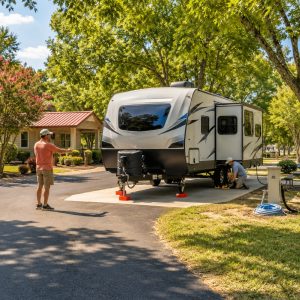
The first hour at any new RV park sets the tone for the whole stay, and it’s the hour that first-time guests specifically tend to feel most uncertain about — where do I actually go, what does check-in involve, and how do I get set up without holding up traffic behind me or missing some rule I didn’t know existed. Here’s a realistic walkthrough of what that first hour typically looks like, and how to make it go smoothly.
Before You Even Arrive: What to Have Ready
A smoother check-in starts before you’re actually on-site. Have your reservation confirmation accessible — on your phone or printed — along with a valid ID and the payment method you used to book, since the office may need to verify these on arrival. Know your rig’s specific dimensions (length including any tow vehicle, height, and width) in case the site assignment process requires confirming it fits your specific space. If you have specific site preferences or requests that weren’t part of your original booking, having those ready to ask about at check-in, rather than assuming they’ll be automatically accommodated, sets realistic expectations from the start.
Step One: The Office and Check-In
Arrival: Head to the Office FirstRegardless of how confident you feel about finding your assigned site, checking in at the office first is the standard process at essentially every RV park, including Texarkana RV Park. This is where you’ll confirm your reservation, receive your specific site assignment or number, get any access codes or keys needed for gate access or amenity areas, and receive a copy of the park’s current rules and any seasonal notices. Confirming current office hours before you arrive — particularly if you’re planning a later arrival — is worth doing, since some smaller properties have specific check-in windows rather than 24-hour staffed offices.
Ask Your Questions Now, Not LaterCheck-in is the right moment to ask about anything you’re unsure of — quiet hours, pet policies and any designated pet areas, trash and recycling procedures, Wi-Fi access details, and the specific location of amenities like the bathhouse, laundry facilities, or any pool or common areas. Staff at the office are generally used to first-time guest questions and would rather answer them upfront than have a guest guess incorrectly and run into an avoidable issue later in the stay.
“The guests who have the smoothest first day are almost always the ones who ask a handful of questions at check-in rather than the ones who nod along and figure it out as they go. Nobody at the front desk thinks less of you for asking where the dump station is or what the quiet hours actually mean in practice.”
Step Two: Finding and Setting Up at Your Site
Locating Your SiteOnce you have your site number, the park should provide either a map or clear signage to help you navigate to it — ask at check-in if this isn’t immediately clear. Drive slowly through the property regardless of how empty it looks; RV parks often have tighter turning radii, speed limits, and pedestrian or pet traffic that isn’t always obvious on a quick initial pass.
The Setup SequenceOnce you’re at your site, the general setup sequence most experienced RVers follow is: level the rig first (using leveling blocks or a built-in leveling system if your rig has one), then connect electrical service, then water, and finally sewer if you’re on a full-hookup site. Doing electrical first (after leveling) means you can confirm your site’s power is working correctly before connecting anything else, and it lets you get AC running immediately if it’s a hot Texarkana summer afternoon, which it usually is.
Confirm the Hookup Type Matches Your BookingIf you booked a specific hookup type — 30-amp or 50-amp, for instance — confirm the site actually has that service before you finish setup, rather than discovering a mismatch after you’ve leveled and started unpacking. If something doesn’t match what you booked, this is exactly the kind of issue worth walking back to the office about immediately rather than trying to work around it for your entire stay.
Understanding the Park’s Rules Before You Settle In
Every RV park has its own specific rule set, and reading through whatever rules document you’re given at check-in — rather than setting it aside unread — saves potential friction later in the stay. Common categories worth understanding specifically: quiet hours (typically enforced more strictly than a hotel might be, given the closer proximity between sites), pet policies (leash requirements, designated relief areas, and any breed or size restrictions), speed limits within the park, guest and visitor policies if you’re expecting anyone to stop by during your stay, and check-out procedures and timing for when your stay ends.
Why These Rules Exist
RV park rules exist primarily to keep a shared living space workable for everyone staying there simultaneously — quiet hours matter more at a campground than a hotel because the walls, so to speak, are much thinner and the outdoor proximity between sites is much closer. Understanding the reasoning behind rules like this makes them easier to actually follow rather than feeling like arbitrary restrictions.
The First Afternoon: Settling In for a Summer Stay
Once you’re set up, the practical priorities for a summer Texarkana arrival shift toward heat management. Get your AC running as soon as electrical is confirmed working, close blinds or window coverings on the sun-facing side of the rig, and if you’re staying for more than a night or two, take the time to identify shade patterns across the day so you know how to position awnings or outdoor furniture for the rest of your stay. If you arrived in the heat of the afternoon, giving yourself permission to just rest inside with the AC running rather than immediately heading out to explore is a completely reasonable way to spend the first few hours.
For guests specifically planning to spend time at Wright Patman Lake or other regional attractions during their stay, getting oriented at the park first — knowing where things are, confirming your setup is solid — makes the actual exploring portion of the trip go more smoothly once you head out the following day.
Before arrival: reservation confirmation, ID, payment method accessible. Know your rig’s dimensions.
Step 1: check in at the office first, always — confirm hours in advance if arriving later in the day.
Ask at check-in: quiet hours, pet policy, trash/recycling, Wi-Fi, amenity locations (bathhouse, laundry, pool).
Step 2: drive slowly to your site using park map/signage. Setup order: level → electrical → water → sewer.
Confirm hookup type matches your booking (30-amp vs. 50-amp) before finishing setup.
Read the rules document you’re given — don’t set it aside unread.
First afternoon in summer: AC running ASAP, blinds closed on sun-facing side, rest is a completely valid first-day plan.
For guests planning a summer stay, current rates and site information are at the RV Park Texarkana pricing page. Guests who’d rather skip RV setup logistics entirely can look at the cabin accommodations at RV Park Texarkana. For the day after arrival, the Wright Patman Lake area guide covers what’s nearby once you’re settled in. The RV travel and Texarkana area guide gives the broader regional picture for planning the rest of your trip. And for booking your stay, RV Park Texarkana is the starting point — feel free to call ahead with any first-time-guest questions before you even arrive.
Frequently Asked Questions
What should I do first when I arrive at an RV park?
Head to the office first, regardless of how confident you feel about locating your assigned site independently. Check-in confirms your reservation, provides your specific site assignment, gives you any access codes needed for gates or amenities, and provides the park’s current rules document. Have your reservation confirmation, a valid ID, and your booking payment method accessible, since the office may need to verify these. This is also the right time to ask any questions about quiet hours, pet policies, amenity locations, or anything else you’re uncertain about before heading to your site.
What order should I connect my RV’s hookups when setting up?
Most experienced RVers follow this general sequence: level the rig first using leveling blocks or a built-in system, then connect electrical service, followed by water, and finally sewer if on a full-hookup site. Connecting electrical early, right after leveling, allows you to confirm the site’s power is functioning correctly and get air conditioning running promptly, which matters specifically during a hot Texarkana summer arrival. Confirming that the hookup type you booked (30-amp or 50-amp) actually matches what’s provided at your site is worth doing during setup, before you’re fully unpacked and settled.
What questions should first-time RV park guests ask at check-in?
Useful questions for first-time guests include: what are the quiet hours and how are they enforced, what is the pet policy including any designated relief areas or leash requirements, what are the trash and recycling procedures, what Wi-Fi access is available and how do you connect, where are the bathhouse, laundry, and any pool or common amenity areas located, and what is the check-out procedure and timing. Asking these questions directly at check-in, rather than guessing or discovering the answers partway through your stay, is the practical approach that experienced RVers consistently recommend for first-time guests.
What are typical RV park rules I should know about before arriving?
Common RV park rules include designated quiet hours (often more strictly enforced than at a hotel given the closer proximity between sites), pet policies covering leash requirements and designated relief areas, speed limits within the property, guest and visitor policies for anyone stopping by during your stay, and specific check-in and check-out timing. These rules exist primarily to keep a shared outdoor living space workable for everyone staying at the park simultaneously. Reading through the specific rules document provided at check-in, rather than setting it aside unread, helps avoid avoidable friction during your stay.
What should I bring or have ready before checking in at an RV park?
Have your reservation confirmation accessible (on your phone or printed), a valid ID, and the payment method used for booking, since the office may need to verify these at check-in. Know your rig’s specific dimensions — length including any tow vehicle, height, and width — in case your site assignment needs confirming against your rig’s size. If you have specific site preferences that weren’t part of your original booking, having those ready to ask about at check-in sets realistic expectations rather than assuming they’ll be automatically accommodated.
What should I do first if I arrive during a hot summer afternoon?
After completing check-in and basic site setup, prioritize getting your air conditioning running as soon as electrical service is confirmed working, and close blinds or window coverings on the sun-facing side of your rig to reduce heat gain. If you’re staying more than a night or two, take note of how shade moves across your site throughout the day so you can plan awning use and outdoor furniture placement for the remainder of your stay. Resting inside with the AC running rather than immediately heading out to explore is a completely reasonable way to spend the first few hours after a hot-weather arrival.