
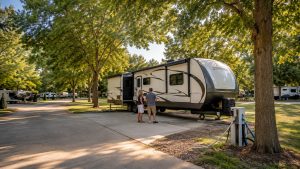
Every family thinking about an RV trip runs the same math in their head at some point: is this actually cheaper than a hotel-based vacation, or does it just feel cheaper because you’re paying for it in smaller pieces? The honest answer for a Lake Champlain trip is that RV camping is genuinely one of the more affordable ways to vacation as a family, but the real savings come from understanding where the actual costs land, not from assuming camping is automatically free just because you’re sleeping in your own rig.
Site Fees: The Foundation Cost
RV site fees at Lake Champlain area campgrounds typically run somewhere in the range of $40 to $75 per night for a full-hookup site during peak summer season, with the specific rate depending on site type, amenities, and whether you’re booking a premium waterfront or lake-view location versus a standard site. This range is a genuinely significant cost saver compared to hotel lodging in the same region during peak summer tourist season, where a comparable family room can easily run $150 to $250 or more per night in the Adirondacks and Champlain Valley area during July and August.
Multi-night and weekly stay discounts are common at many campgrounds, which meaningfully improves the per-night cost for a longer stay compared to booking the same number of nights individually. Checking current rates directly is always the right move since seasonal pricing and specific site availability shift — the current pricing at Lake Champlain RV Park gives the specific rate structure for planning an actual trip budget rather than working from a general regional estimate.
Fuel: The Variable That Actually Depends on Your Rig
Fuel cost is the single most variable line item in an RV trip budget, and it depends heavily on what you’re driving, how far you’re traveling, and whether you’re towing or driving a motorized rig. A large Class A motorhome or a heavy fifth wheel being towed by a full-size truck might average 8 to 10 miles per gallon, while a smaller travel trailer towed by a mid-size SUV or truck might manage 14 to 18 miles per gallon. At current diesel and gasoline prices, this difference meaningfully changes the total fuel cost for the same trip distance.
For families driving a moderate distance to reach the Lake Champlain area — say, 200 to 400 miles each way from the broader Northeast — total round-trip fuel cost for a typical family-sized towable rig commonly lands somewhere in the $150 to $400 range, though this varies considerably with rig efficiency, current fuel prices, and exact distance. Once you’ve arrived, local fuel use for day trips around the Adirondacks and Champlain Valley area adds a modest additional cost, but nothing close to the initial travel fuel expense.
Reducing Fuel Costs
Combining errands and day trips into fewer, more efficient outings rather than multiple separate drives, maintaining reasonable highway speeds during travel (fuel efficiency drops meaningfully above roughly 65 mph for most tow vehicles), and keeping your rig’s tires properly inflated all contribute to modest but real fuel savings across a multi-day trip.
Food: Where RV Travel Genuinely Saves Money
This is the category where RV camping produces its clearest financial advantage over a hotel-based vacation. A family of four eating three restaurant meals a day during a week-long trip can easily spend $300 to $500 or more just on food, while the same family cooking most meals in their own RV kitchen, supplemented by occasional restaurant meals or local farmers market finds, often spends a fraction of that — commonly in the $150 to $250 range for a full week of groceries for a family of four, depending on how many restaurant meals are mixed in.
“The food savings are the part people underestimate the most going into their first RV trip. You’re not just saving money — you’re also not spending an hour finding a restaurant with parking and a table for six at 6:30 on a Saturday. Cooking your own dinner at the site after a full day at the lake is honestly one of the better parts of the trip, not just the cheaper one.”
Activities: The Category You Actually Control Most
Lake Champlain itself is largely a free or low-cost activity resource — swimming, kayaking or paddleboarding (if you bring your own equipment), and hiking at state parks like Point au Roche typically involve only a modest day-use parking fee, commonly in the $8 to $12 range per vehicle at New York state parks. This is dramatically cheaper than a typical paid attraction ticket, and it’s a big part of why a lake-based RV trip can stay genuinely affordable compared to a trip built around paid attractions and theme parks.
Paid activities — boat rentals, guided tours, museum admissions in Plattsburgh, a round of golf, or equipment rentals for kayaking or paddleboarding if you don’t own your own — add up depending entirely on how many you choose to include. A trip that leans heavily on the free lake access and hiking, with one or two paid activities mixed in across a week, keeps the activity budget genuinely modest; a trip that includes daily paid attractions will run meaningfully higher.
Putting Together a Sample Weekly Budget
Here’s a realistic illustration for a family of four on a 7-night Lake Champlain RV trip, combining the categories above. These are planning ranges, not guaranteed figures — actual costs depend on your specific rig, travel distance, and choices along the way.
| Category | Low Estimate | Higher Estimate |
|---|---|---|
| Site fees (7 nights) | $280 | $525 |
| Round-trip fuel | $150 | $400 |
| Food (groceries + a few meals out) | $180 | $320 |
| Activities (park fees + 1-2 paid extras) | $60 | $180 |
| Estimated weekly total | ~$670 | ~$1,425 |
For comparison, a hotel-based week-long vacation for the same family in the same region during peak summer — factoring lodging, all restaurant meals, and similar activity spending — commonly runs meaningfully higher, often landing in the $2,000 to $3,500+ range once lodging and full restaurant dining are factored in. The RV trip’s savings come primarily from the lodging and food categories, which is exactly where camping structurally differs from a hotel stay.
Tips for Keeping the Trip on the Lower End of the Range
Book a shorter or off-peak-adjacent stay when possible — early or late summer weekdays often carry lower demand than peak July and August weekends, which can affect both rate availability and crowding at popular activities. Plan meals in advance and shop for a full week’s groceries in one or two trips rather than daily convenience-store runs, which tend to cost more per item. Lean on the lake’s free and low-cost recreation (swimming, hiking, the beach) rather than defaulting to paid attractions for daily entertainment. And if your trip length is flexible, checking whether a short-term RV park stay or a longer weekly-rate booking produces a better overall per-night cost for your specific trip length is worth the few minutes of comparison before booking.
Site fees: ~$40-75/night full hookup, peak season. Multi-night/weekly discounts common.
Fuel: highly rig-dependent. ~$150-400 round trip for a 200-400 mile drive each way, family towable rig.
Food: ~$150-250/week groceries (family of four) vs. $300-500+/week all-restaurant. This is the category with the clearest RV savings.
Activities: lake access and hiking often just a state park day-use fee (~$8-12/vehicle). Paid extras add up based on choices.
Sample 7-night total: roughly $670 (lean) to $1,425 (moderate) for a family of four — versus $2,000-3,500+ for a comparable hotel-based week in the same region.
Confirm current site rates directly before finalizing a trip budget, since seasonal pricing shifts.
For an accurate trip budget, confirming current site rates directly is always the right first step — the Lake Champlain RV Park pricing page gives the specific numbers to plug into your own version of this budget breakdown.
Frequently Asked Questions
Is RV camping cheaper than a hotel vacation at Lake Champlain?
Generally, yes, and the savings are most significant in the lodging and food categories. RV site fees at Lake Champlain area campgrounds commonly run $40 to $75 per night during peak season, compared to $150 to $250 or more for a comparable family hotel room in the region during the same period. Food costs also drop substantially when cooking most meals in your own RV kitchen rather than eating out for every meal. For a family of four on a 7-night trip, total costs commonly land somewhere between roughly $670 and $1,425 depending on choices, compared to $2,000 to $3,500 or more for a similar hotel-based week with full restaurant dining.
How much does fuel cost for an RV trip to Lake Champlain?
Fuel cost depends heavily on your specific rig’s fuel efficiency and your travel distance. A large motorhome or heavy towed rig might average 8 to 10 miles per gallon, while a smaller travel trailer towed by a mid-size vehicle might manage 14 to 18 miles per gallon. For a round trip of 200 to 400 miles each way from elsewhere in the Northeast, total fuel costs for a typical family towable rig commonly range from $150 to $400, though this varies with current fuel prices and your specific vehicle and trailer combination. Maintaining reasonable highway speeds and properly inflated tires help modestly reduce fuel costs.
What are the biggest cost-saving opportunities for an RV trip?
Food preparation is typically the single biggest cost-saving category — cooking most meals in your own RV kitchen rather than eating out commonly saves a family of four several hundred dollars over a week-long trip compared to all-restaurant dining. Leaning on free or low-cost activities, particularly lake access and hiking at state parks (which typically involve only a modest day-use parking fee), rather than defaulting to paid attractions, is the second major savings opportunity. Booking multi-night or weekly rate discounts when staying longer, and traveling during shoulder periods rather than peak summer weekends when possible, round out the most impactful cost-saving strategies.
How much do state park day-use fees cost near Lake Champlain?
New York state park day-use parking fees typically run in the $8 to $12 range per vehicle, giving access to swimming beaches, hiking trails, and picnic areas at parks like Point au Roche State Park near Lake Champlain. This is dramatically less expensive than most paid tourist attractions, which is a significant reason why a lake-based RV vacation built around swimming, hiking, and beach time can stay genuinely affordable compared to a trip built around theme parks or other ticketed attractions.
Are multi-night or weekly RV site rates cheaper than nightly rates?
Yes, commonly. Many campgrounds, including properties in the Lake Champlain area, offer discounted rates for multi-night or weekly stays compared to booking the same number of nights individually at the standard nightly rate. For families planning a week-long or longer stay, checking whether a weekly rate produces meaningful savings over the nightly rate for the same duration is worth doing before booking, since the discount can be a meaningful percentage of the total site fee cost for the trip.
What is a realistic total budget for a week-long RV trip to Lake Champlain?
For a family of four on a 7-night trip, combining site fees, round-trip fuel, food, and activities, a realistic total budget commonly ranges from approximately $670 on the lean end (careful meal planning, mostly free lake and hiking activities, efficient fuel use) to approximately $1,425 on the higher end (some restaurant meals, a couple of paid activities, less fuel-efficient rig). These are planning ranges rather than guaranteed figures, since actual costs depend heavily on your specific rig’s fuel efficiency, travel distance, and choices around food and activities during the trip. Confirming current site rates directly with the campground you’re booking gives the most accurate number for that specific cost category.