
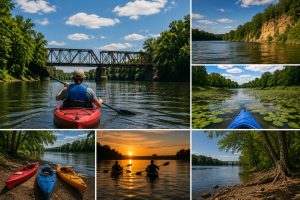
The Ark-La-Tex region doesn’t get talked about as a paddling destination the way the Texas Hill Country rivers or the Gulf Coast do. That’s a gap worth closing — Texarkana sits within reach of some genuinely excellent water, from a major reservoir to one of the most distinctive cypress swamps in the country.
Wright Patman Lake: The Closest Big Water
Wright Patman Lake, approximately 20 miles south of Texarkana on the Sulphur River, is the most accessible significant paddling destination in the immediate area. It’s a US Army Corps of Engineers reservoir covering roughly 20,300 acres at normal pool, with multiple boat ramps and access points around its shoreline that make kayak and canoe launching straightforward.
Kayaking Wright Patman Lake works well for several different paddling interests. The main lake body offers open-water paddling with enough size to feel like a genuine lake expedition rather than a pond circuit. The numerous coves and inlets along the shoreline — particularly on the lake’s upper reaches where the Sulphur River feeds in — provide more sheltered paddling that’s appropriate for less experienced paddlers or anyone who prefers calmer water with more shoreline interest. Wind exposure on the open lake body can be significant on breezy days; checking wind forecasts before planning an open-water crossing is worth the two minutes it takes.
Fishing From a Kayak at Wright Patman
The lake’s strong bass, crappie, and catfish fishery makes kayak fishing a popular activity alongside recreational paddling. Kayak anglers access coves and shallow structure that motorized boats either can’t reach or disturb with engine noise before the angler gets a cast in. The lake’s standing timber in several coves — flooded forest from before the reservoir was built — provides exactly the kind of structure that bass relate to and that a kayak can navigate quietly through.
“Wright Patman from a kayak is a different lake than Wright Patman from a bass boat. The standing timber coves that motorboats avoid are exactly where a kayak gets you closest to the fish and the quiet.”
Caddo Lake: The Region’s Most Distinctive Paddle
Caddo Lake, approximately 60 to 70 miles south of Texarkana via US-59, is in a category by itself among regional paddling destinations. It’s the only natural lake in Texas — formed by a massive log jam on the Red River in the early 19th century rather than by dam construction — and it’s a National Natural Landmark and Ramsar Wetland of International Importance, covering 25,400 acres of open lake and cypress swamp.
Paddling Caddo Lake is unlike paddling any reservoir or river in the region. The bald cypress trees, many of them centuries old, rise directly from the water with their characteristic buttressed trunks and knees, draped in Spanish moss that creates a specific atmospheric quality that’s genuinely unusual in Texas. The lake’s marked boat trails through the cypress maze help paddlers navigate the otherwise confusing network of channels, sloughs, and open-water bayous that make up the lake’s interior. Without local knowledge or a guide, getting lost in the cypress maze is a real risk — the channels look similar in multiple directions and GPS signal can be unreliable under dense cypress canopy.
Guided Paddling at Caddo Lake
For first-time visitors specifically, a guided paddle tour with a local Caddo Lake outfitter is the recommended approach. Local guides know the navigable channels, the areas with the best wildlife viewing, and the history of the lake’s specific features — the steamboat era history, the bald cypress ecology, and the wildlife that the swamp supports (alligators are present in the lake, along with a significant bird population including herons, egrets, anhinga, and osprey). Several outfitters in the Uncertain, Texas area (the small community on the lake’s western shore) offer both guided tours and self-guided rentals for paddlers comfortable navigating independently.
The Sulphur River and Smaller Creek Paddling
For paddlers who prefer moving water and a more intimate river experience over open-lake paddling, the Sulphur River system above and below Wright Patman Lake offers canoeing in Texas at a smaller, quieter scale. The river above the lake (north and west of Texarkana) runs through bottomland hardwood forest with a slow current appropriate for casual paddling, while sections below the dam (released flow from the reservoir) offer different character depending on release rates.
River paddling on the Sulphur and its tributaries requires more local knowledge than lake paddling — water levels, access points, and any obstacles (downed trees, low water hazards) change with conditions in ways that lake paddling doesn’t. Checking with local outfitters or paddling clubs for current river conditions before a river trip is worth the call, particularly after recent rain events that can change flow rates significantly.
Practical Paddling Logistics for the Texarkana Area
Several practical considerations apply across all the water recreation in Texarkana options worth knowing before you load the kayak.
Best Time of Year
Spring (March through May) and fall (September through November) offer the most comfortable paddling temperatures and avoid the peak heat and humidity of the East Texas summer. Spring paddling also coincides with the best wildlife activity — migratory birds moving through the region make spring trips to Caddo Lake and the Wright Patman shoreline particularly rewarding for birders. Summer paddling is entirely feasible but requires early morning starts to avoid the worst heat, sun protection, and significant hydration planning. Winter paddling on the open lake water is possible on mild days but requires cold-water safety awareness — a capsize in 45°F water in January is a genuinely serious situation regardless of air temperature.
Gear and Safety
A properly fitted personal flotation device is mandatory regardless of swimming ability or water conditions — Texas and Arkansas both require PFDs to be worn or readily accessible per applicable regulations, and conditions on open water can change faster than expected. Sun protection (hat, sunglasses, sunscreen, UPF clothing) matters significantly given the direct sun exposure that open water paddling produces with no shade. A dry bag for phone, keys, and any electronics protects against the inevitable splash or unexpected capsize. For Caddo Lake specifically, a GPS device or detailed lake map is worth carrying given the navigational complexity of the cypress channel system, even for paddlers who are confident in their navigation.
Wright Patman Lake: 20 miles south. Open-water paddling, kayak fishing, standing timber coves. Best for: big water, fishing, accessible launches.
Caddo Lake: 60–70 miles south via US-59. Cypress swamp, marked boat trails, guided tours recommended for first visit. Best for: scenery, wildlife, a special trip.
Sulphur River: above and below Wright Patman Lake. River paddling, bottomland hardwood forest. Best for: moving water, solitude, intimate scale.
Best season: spring and fall for comfort and wildlife. Summer requires early starts; winter requires cold-water safety awareness.
For RV travelers based at the lake itself, the Wright Patman Lake RV park puts you directly at the water with the shortest possible distance from rig to kayak launch. The RVing and Texarkana area travel guide covers the broader regional picture for visitors planning an outdoor-focused stay in the Texarkana corridor.
Frequently Asked Questions
Where can I launch a kayak at Wright Patman Lake?
Wright Patman Lake has multiple US Army Corps of Engineers-managed boat ramps and access points around its shoreline, with several specifically convenient for kayak and canoe launching given the lower water and easier carry distance compared to larger boat ramps designed for trailered boats. The upper reaches near the Sulphur River inflow and several of the developed recreation areas around the lake offer good kayak access. Checking the Corps of Engineers Wright Patman Lake page or contacting the lake’s management office for current ramp conditions and any closures before a trip is advisable, as water levels and ramp accessibility can change with lake management operations.
Is Caddo Lake good for beginner kayakers?
Caddo Lake’s calm water and lack of current make it physically accessible for beginner paddlers in terms of paddling skill required. The challenge for beginners is navigational rather than physical — the cypress maze of channels and sloughs can be confusing, and getting disoriented in the dense cypress canopy (where GPS signal can be unreliable) is a real risk for unguided first-time visitors. For beginners, a guided tour with a local Caddo Lake outfitter is the recommended approach — it removes the navigation risk while still providing the full scenic and wildlife-viewing experience. Self-guided paddling on the lake’s marked boat trails is feasible for beginners who stay close to the marked routes and don’t venture into unmarked channels.
How far is Caddo Lake from Texarkana?
Caddo Lake is approximately 60 to 70 miles south of Texarkana via US-59, with a drive time of roughly 60 to 80 minutes depending on the specific access point. The main access community is Uncertain, Texas, on the lake’s western shore, where most outfitters and guided tour operators are based. Caddo Lake State Park, near Karnack, TX, is another primary access point with its own boat launch. Given the drive distance, Caddo Lake works better as a planned day trip or overnight destination than a casual after-work paddle — most Texarkana-area visitors treat it as a specific destination trip rather than a routine outing.
Are there alligators in Caddo Lake?
Yes. American alligators are present in Caddo Lake, as the lake sits within the alligator’s natural range in East Texas and Northwest Louisiana. Alligators in Caddo Lake are generally not aggressive toward paddlers who maintain reasonable distance and don’t provoke or feed them — encounters are typically limited to sightings rather than dangerous interactions. Standard alligator safety practices apply: maintain distance, never feed alligators, keep pets and small children close and supervised, and avoid paddling at dusk or after dark when alligator activity increases and visibility decreases. Local outfitters and guides can provide current information on alligator activity and any specific areas to be aware of during a given season.
What is the best season for paddling near Texarkana?
Spring (March through May) and fall (September through November) offer the most comfortable temperatures and the best wildlife viewing, particularly bird migration in spring. Summer (June through August) is fully paddleable but requires early morning starts to avoid peak heat, with East Texas humidity adding to the heat burden by midday. Winter paddling is possible on mild days but requires cold-water safety preparation — water temperatures in the 40s°F in January make an unplanned capsize a serious cold-water immersion event regardless of how mild the air temperature feels. For most visitors, a spring or fall trip produces the most comfortable and rewarding paddling experience in the Texarkana area.
Do I need a permit or license to kayak near Texarkana?
Texas and Arkansas do not require a fishing or boating license simply to paddle a kayak or canoe for recreational purposes. If you’re fishing from the kayak, a valid Texas or Arkansas fishing license (depending on which state’s waters you’re fishing) is required for anyone 17 and older, with some exceptions. Texas requires kayaks and canoes to be registered with the Texas Parks and Wildlife Department if they’re paddled on public water and meet certain criteria — specifically, vessels with mechanical propulsion require registration, while paddle-only canoes and kayaks generally do not. Checking current Texas Parks and Wildlife Department requirements (tpwd.texas.gov) before a trip confirms the specific rules applicable to your vessel and planned use.